“‘Do you want to be a martyr?’ Gabe asked, raising his eyebrows.”
“‘I guess. Yes, actually. Something like that.’”
“‘Cyrus,’ Gabe said with a smile, ‘you can’t even wash your own dirty laundry.’ He nodded toward Cyrus’s shirt, wrinkled and splattered with coffee stains around the collar. ‘You think you’ll be able to strap a bomb to your chest and walk into a café?’”
“Martyr!”, Kaveh Akbar
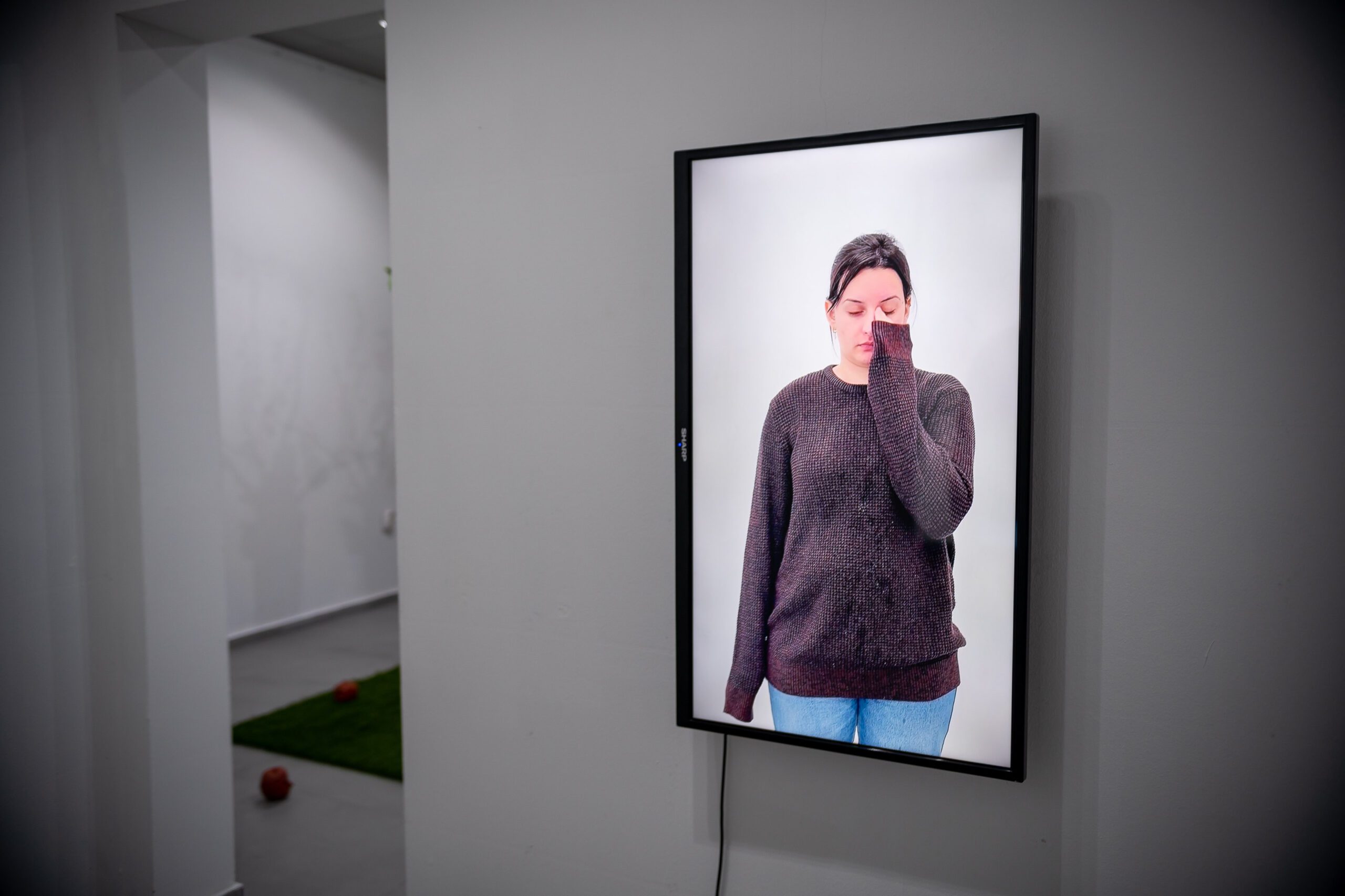
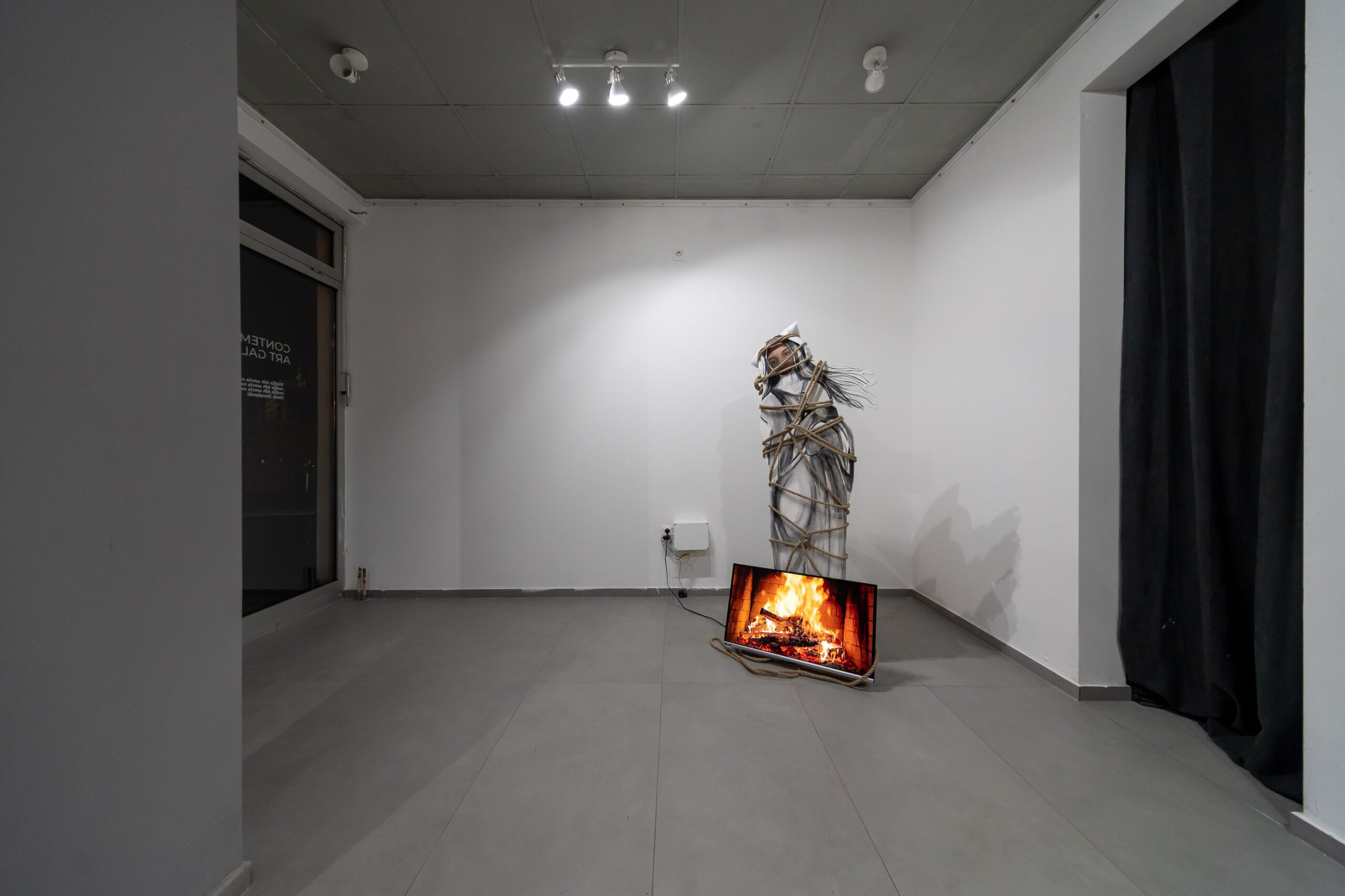
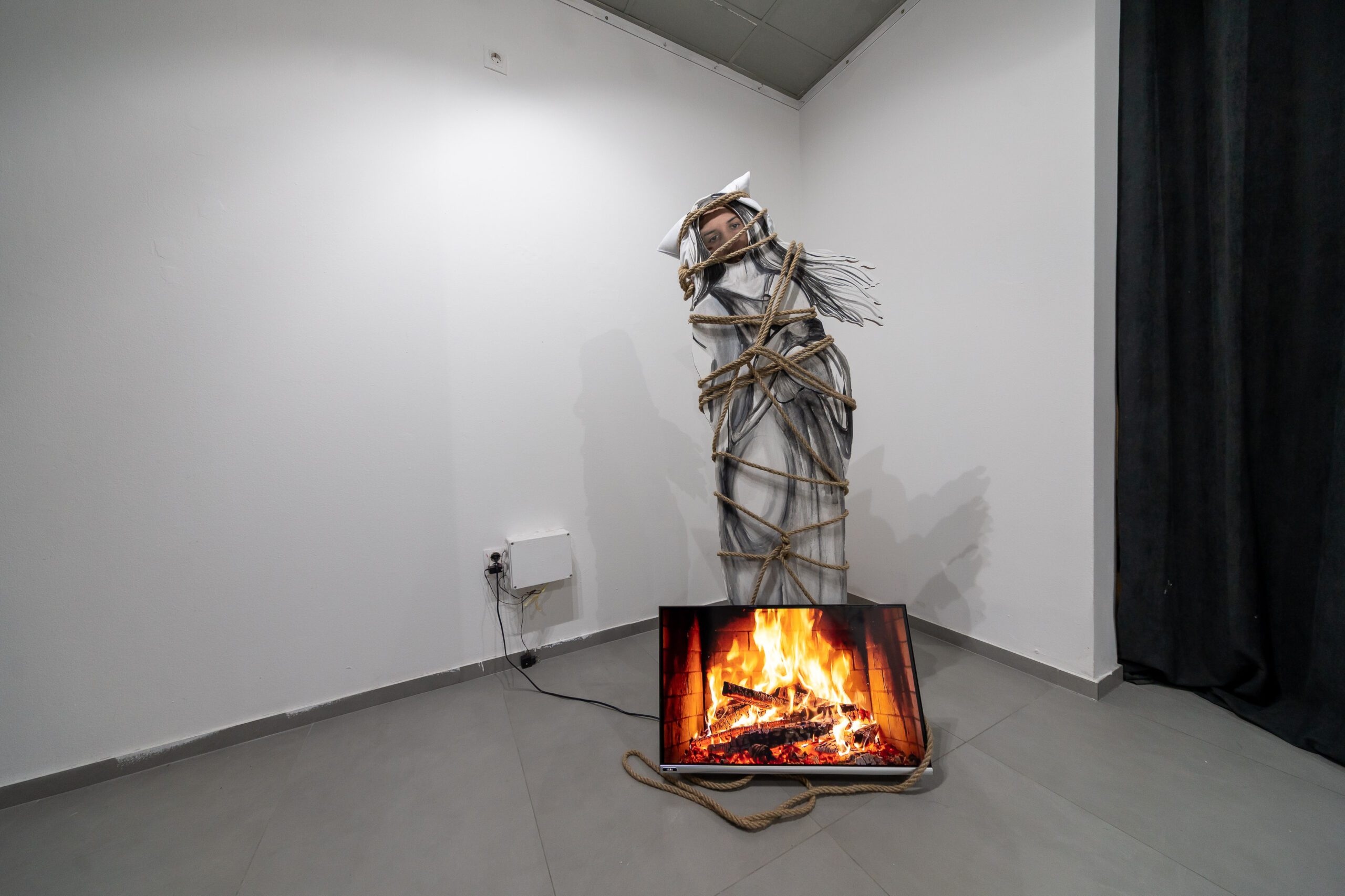
A part of the dialogue, taken from the novel “Martyr!”, brought me back to a conversation with an artist who, alluding to her work “I would rather die than sin”, spoke ironically about martyrdom complexes, placing her own face in the context of Joan of Arc. In the discussion about the work, she says: “We turn ourselves into great victims. You are far from Joan of Arc; you are not at the stake, this is a YouTube little fire.”
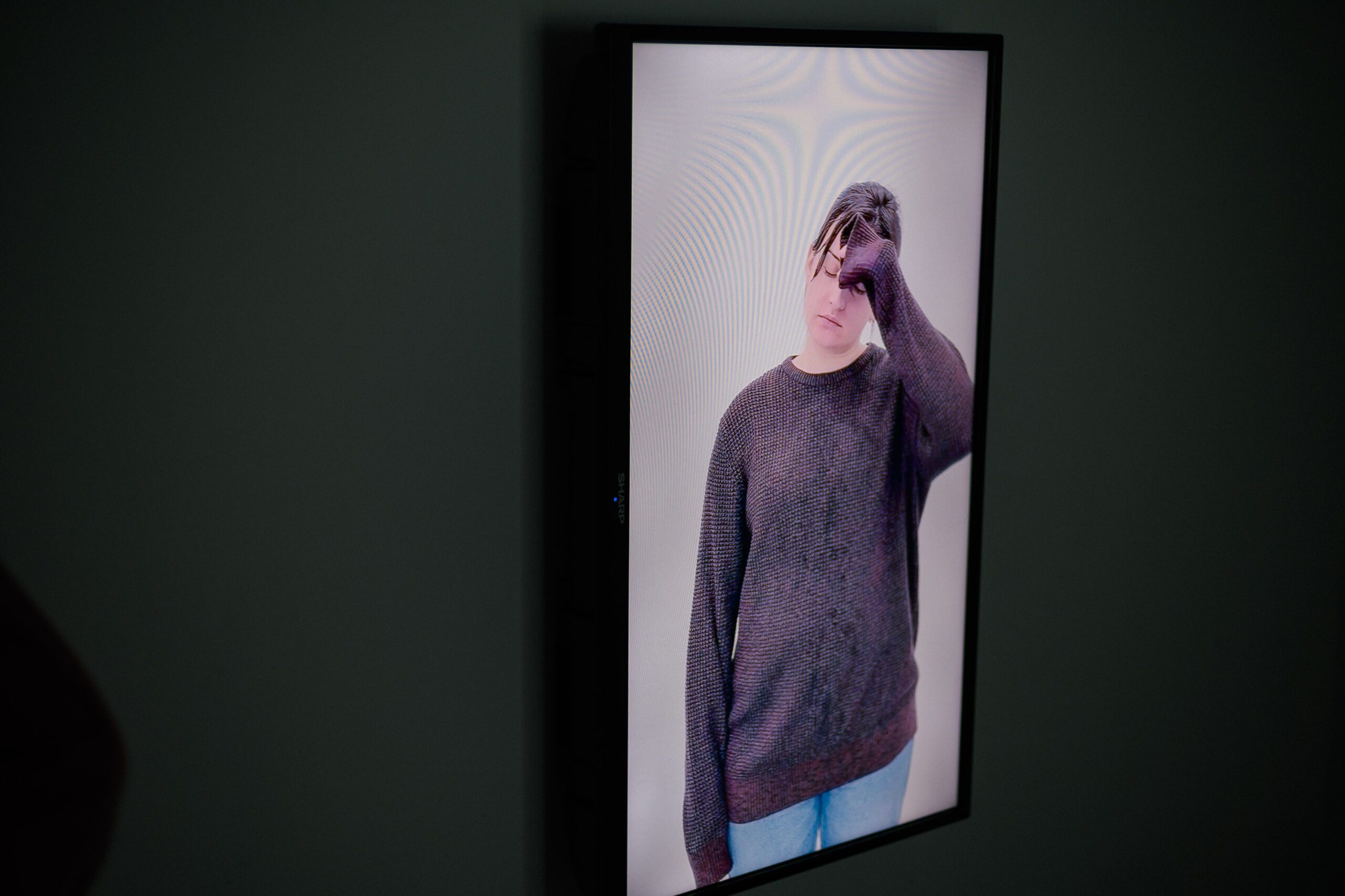
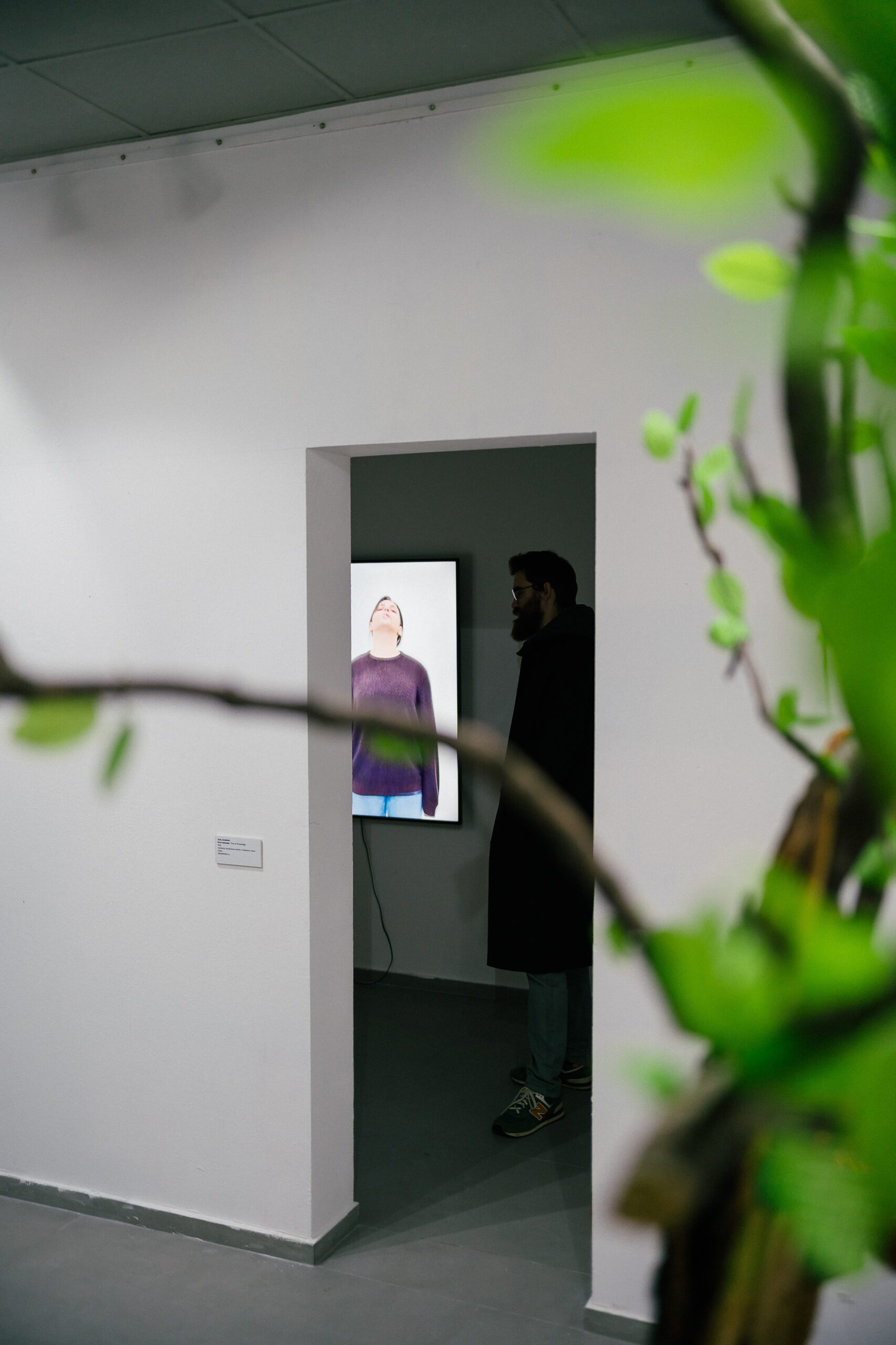
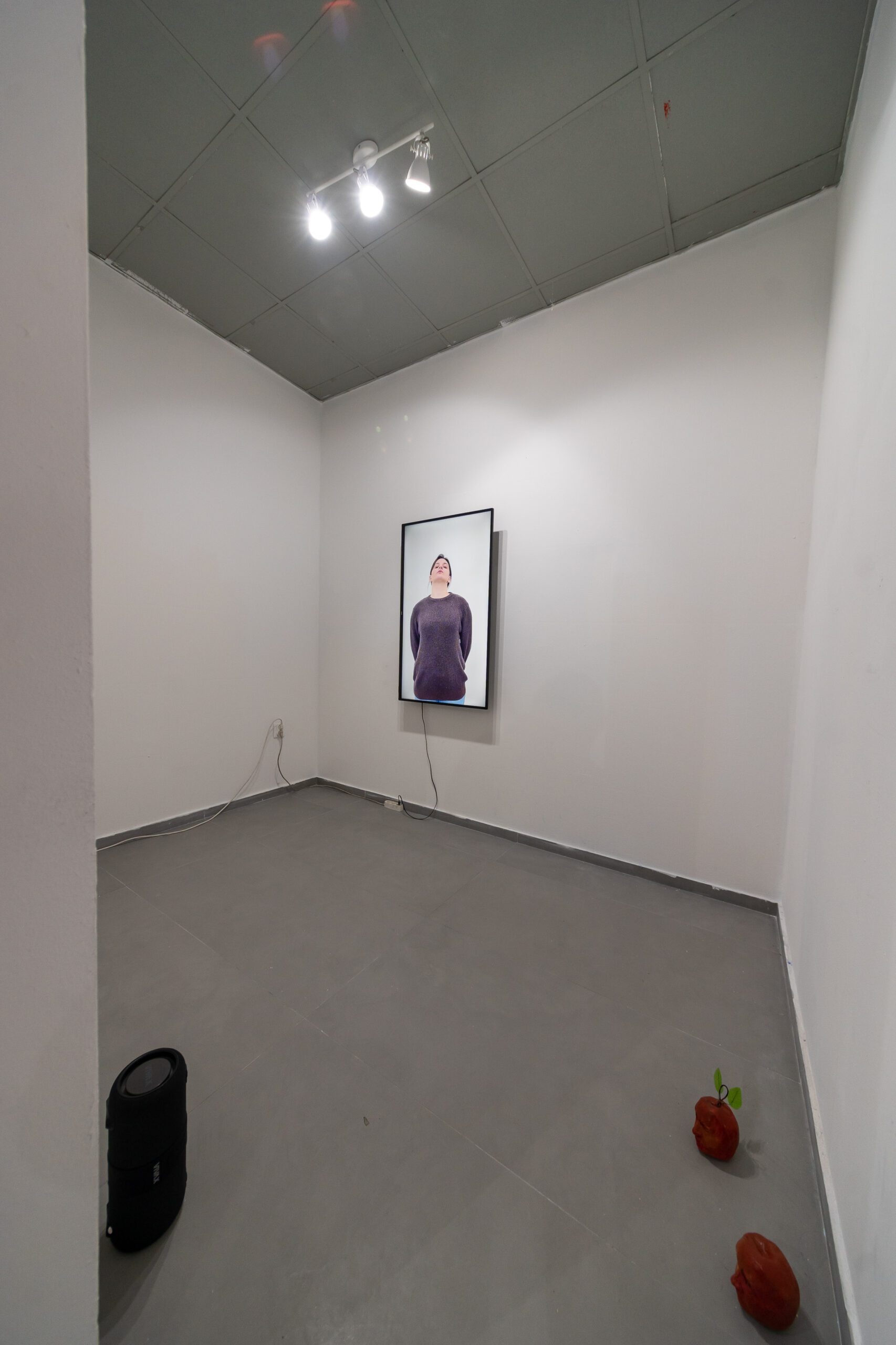
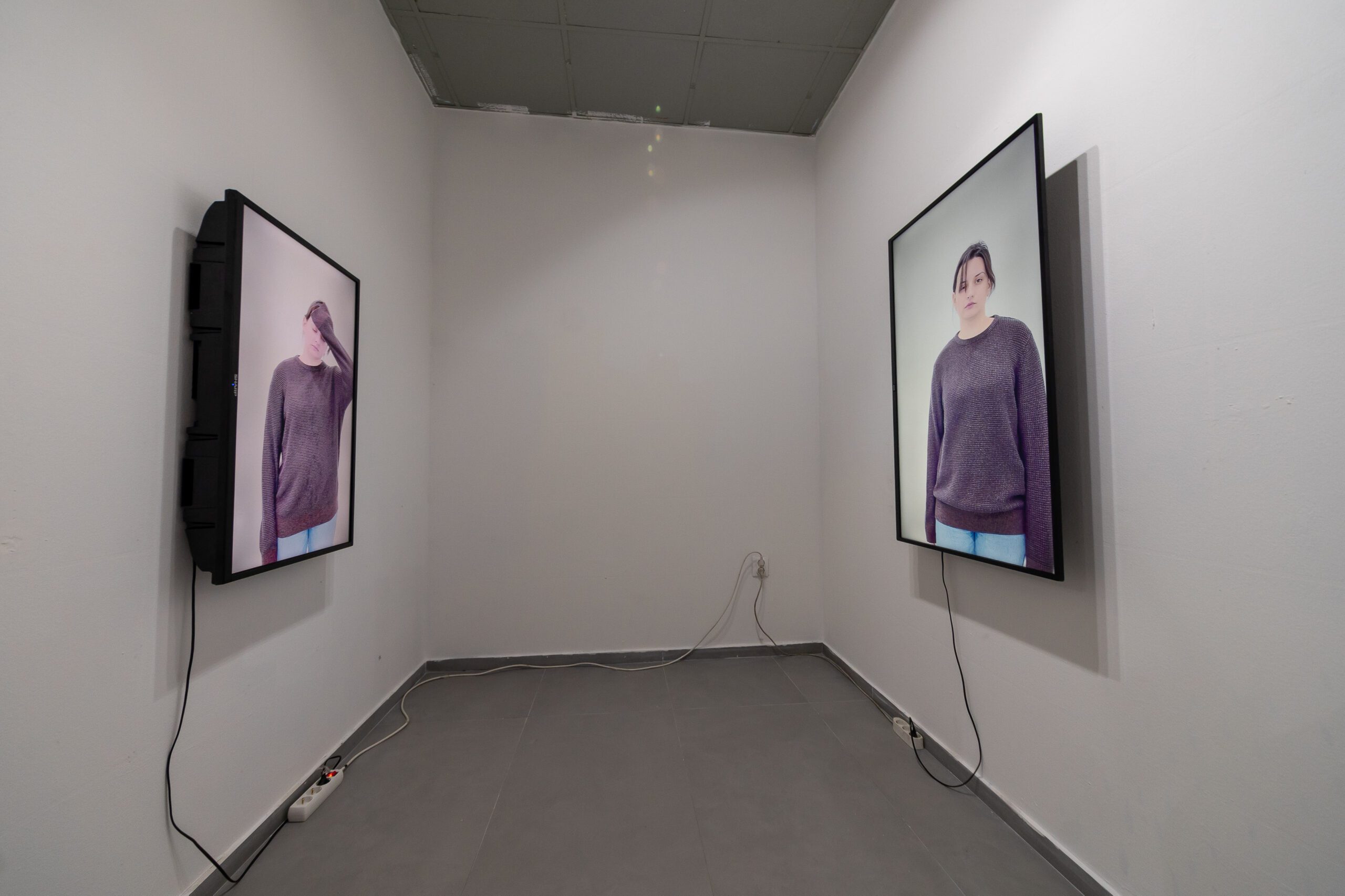
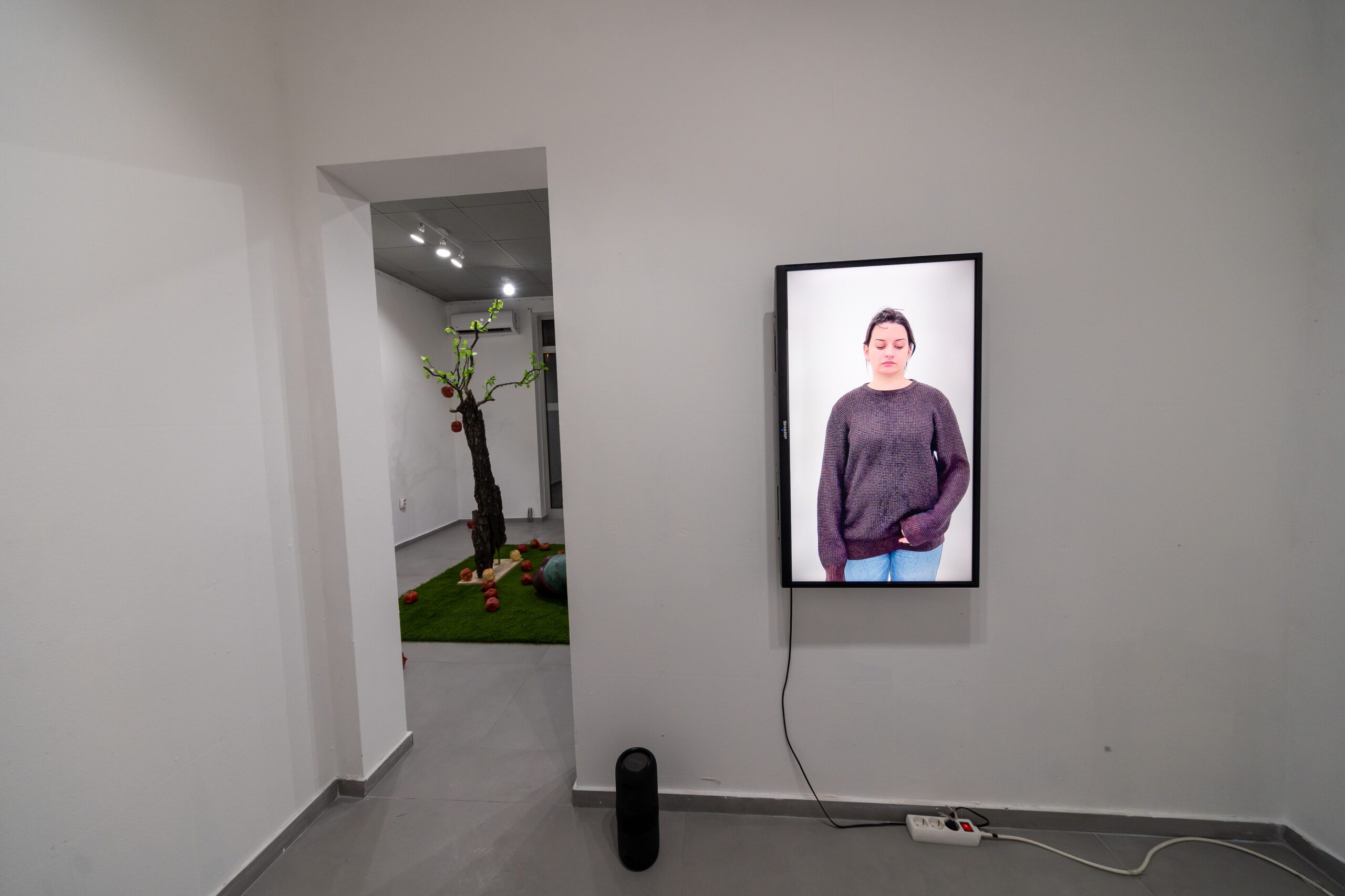
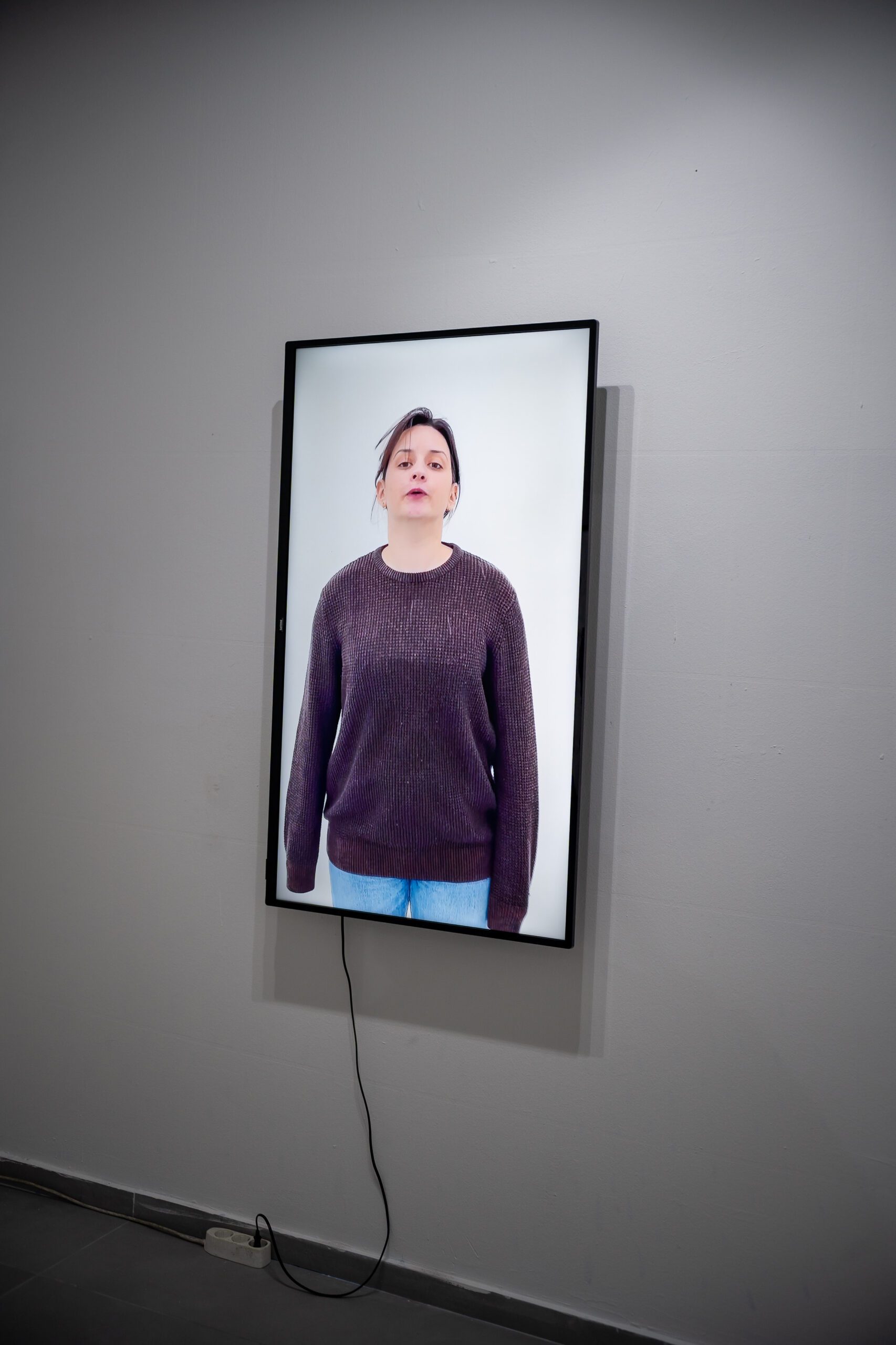
In an approach full of humor, light execution, irony, and a skillful representation of models of self-contempt, Jana Jovašević raises a multitude of questions about everyday overloads, the martyrdom complex and rumination, as well as about artificial methods of resistance that are also present in our daily lives.
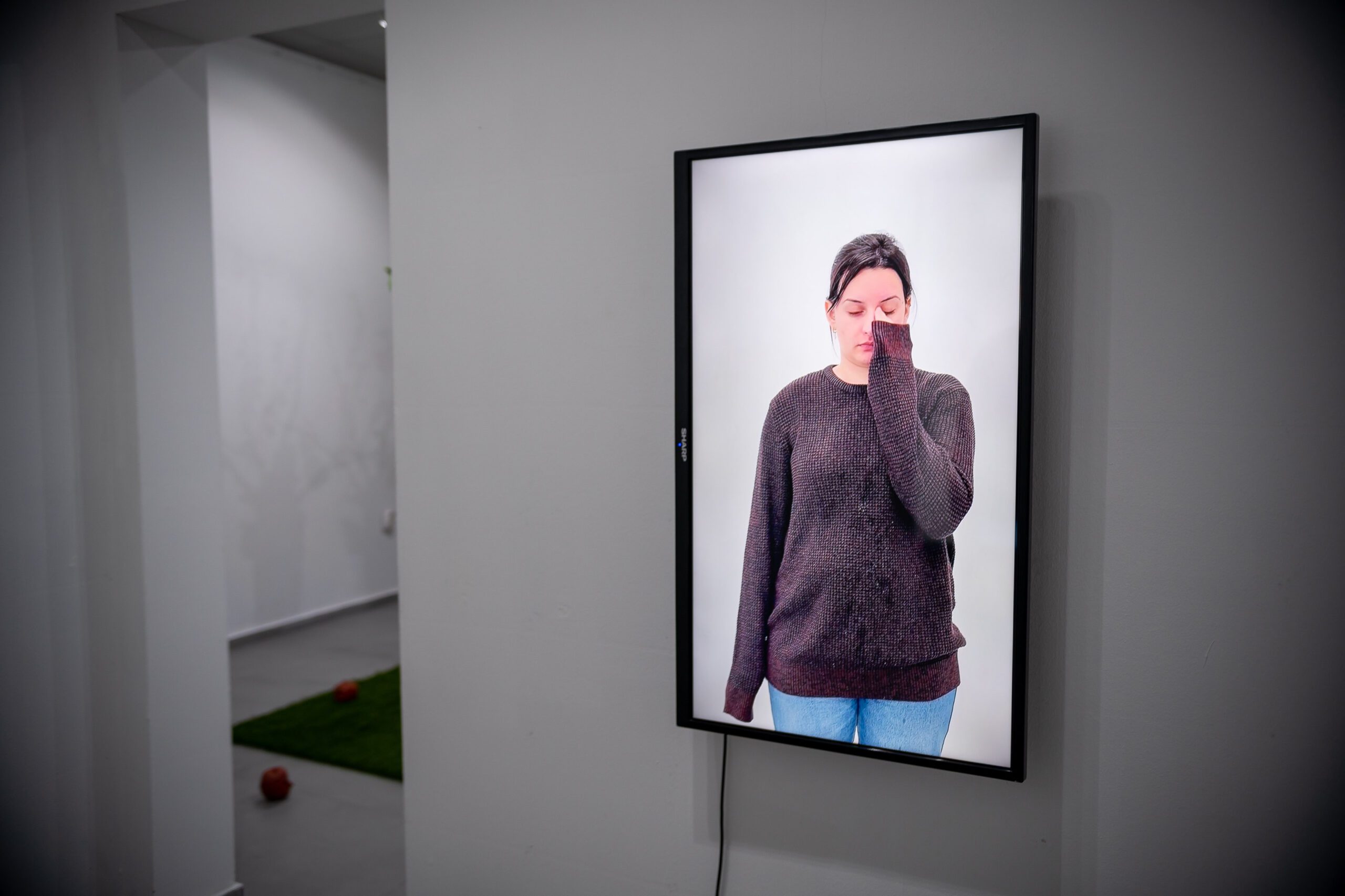
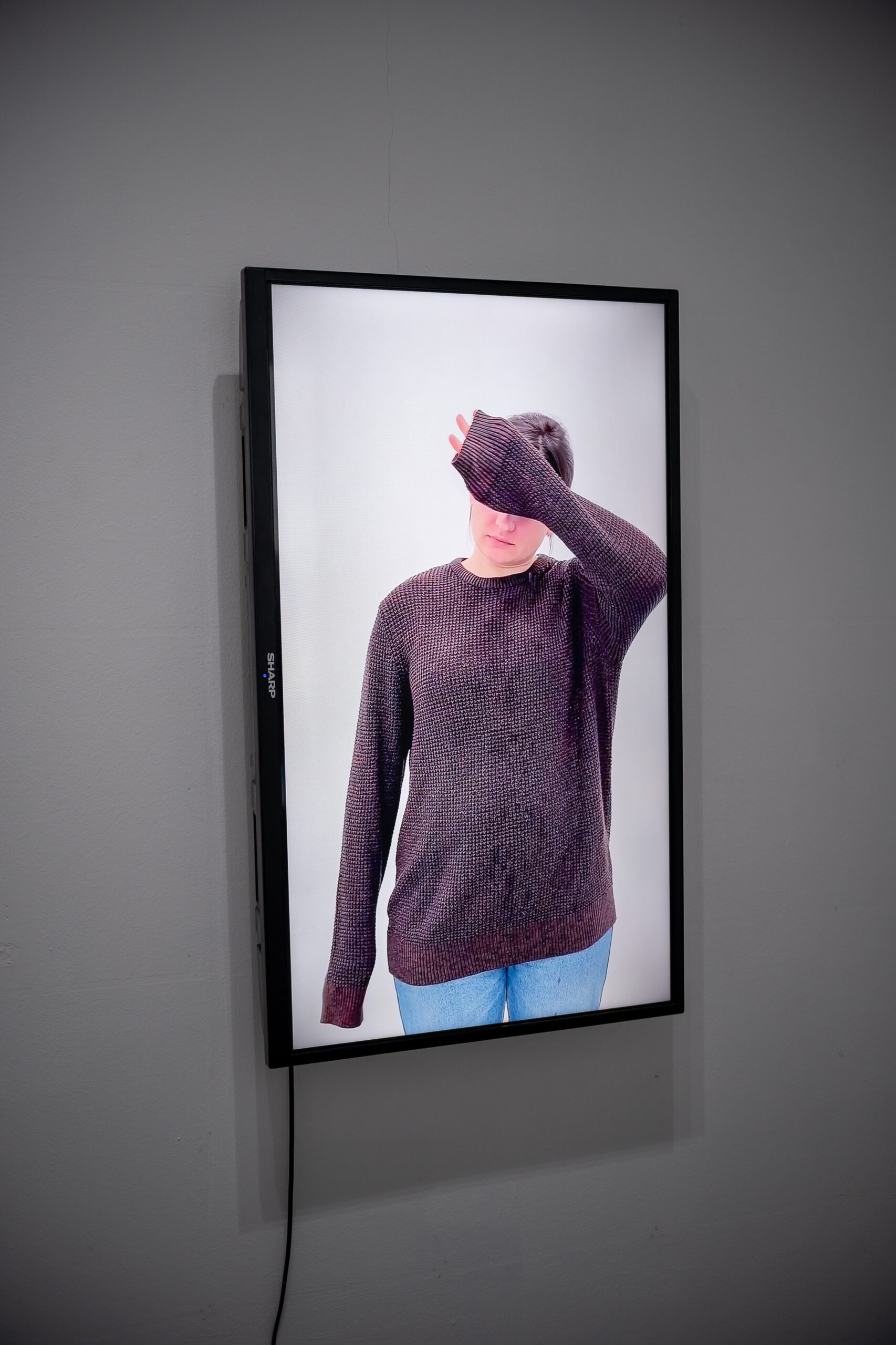
Jovašević operates with self-criticism that is both a tool and a subject of this exhibition. Through a lightness that is not escapism but a conscious strategy of confronting generational rigidities and social conventions in which we participate, often against our own will, the works function as self-portraits that are de-sexualized, exposed, and ridiculed, turning one’s own face into a product of prohibition, an object of contempt, or a heroine whose suffering is comically inadequate.
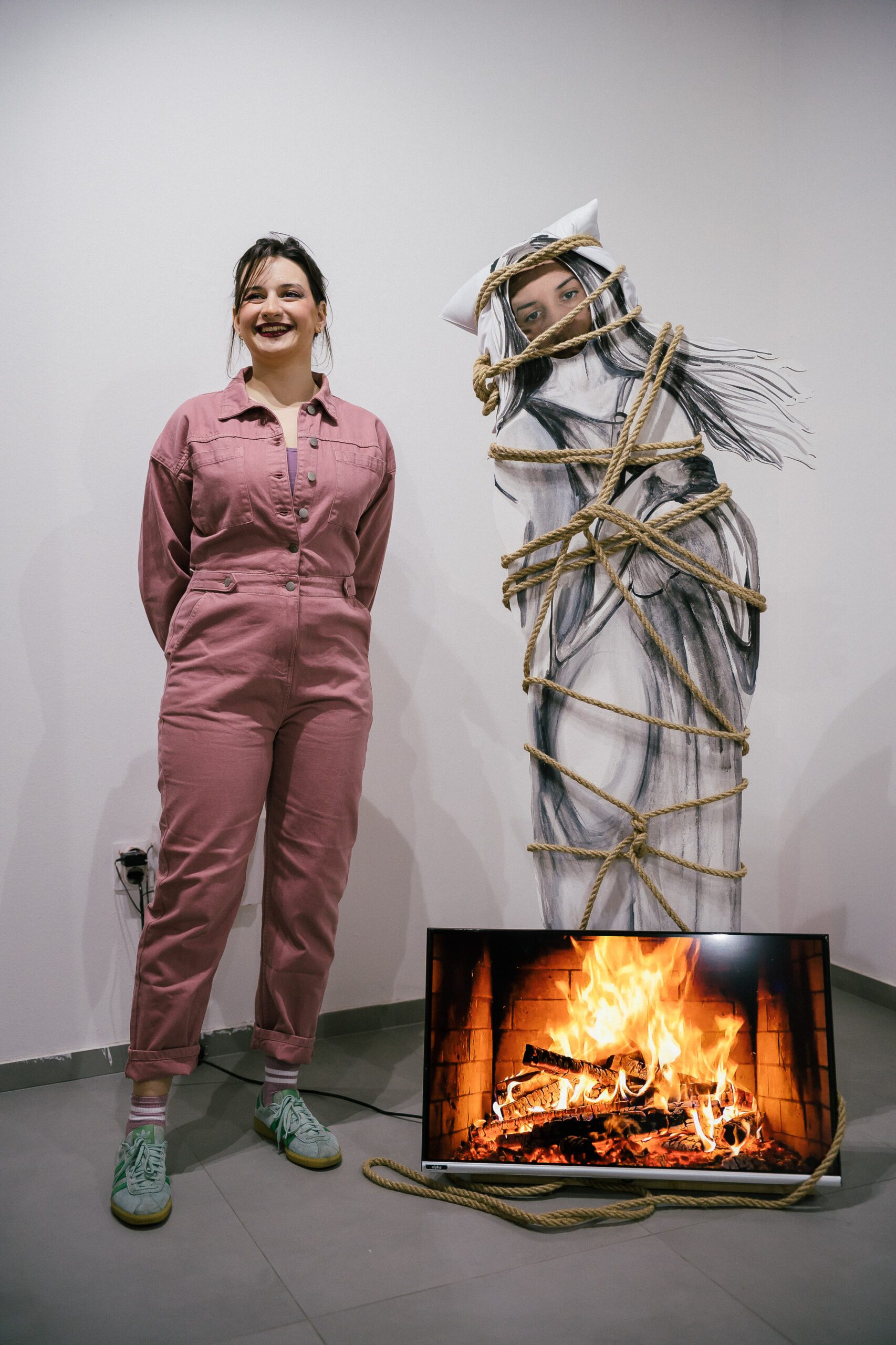
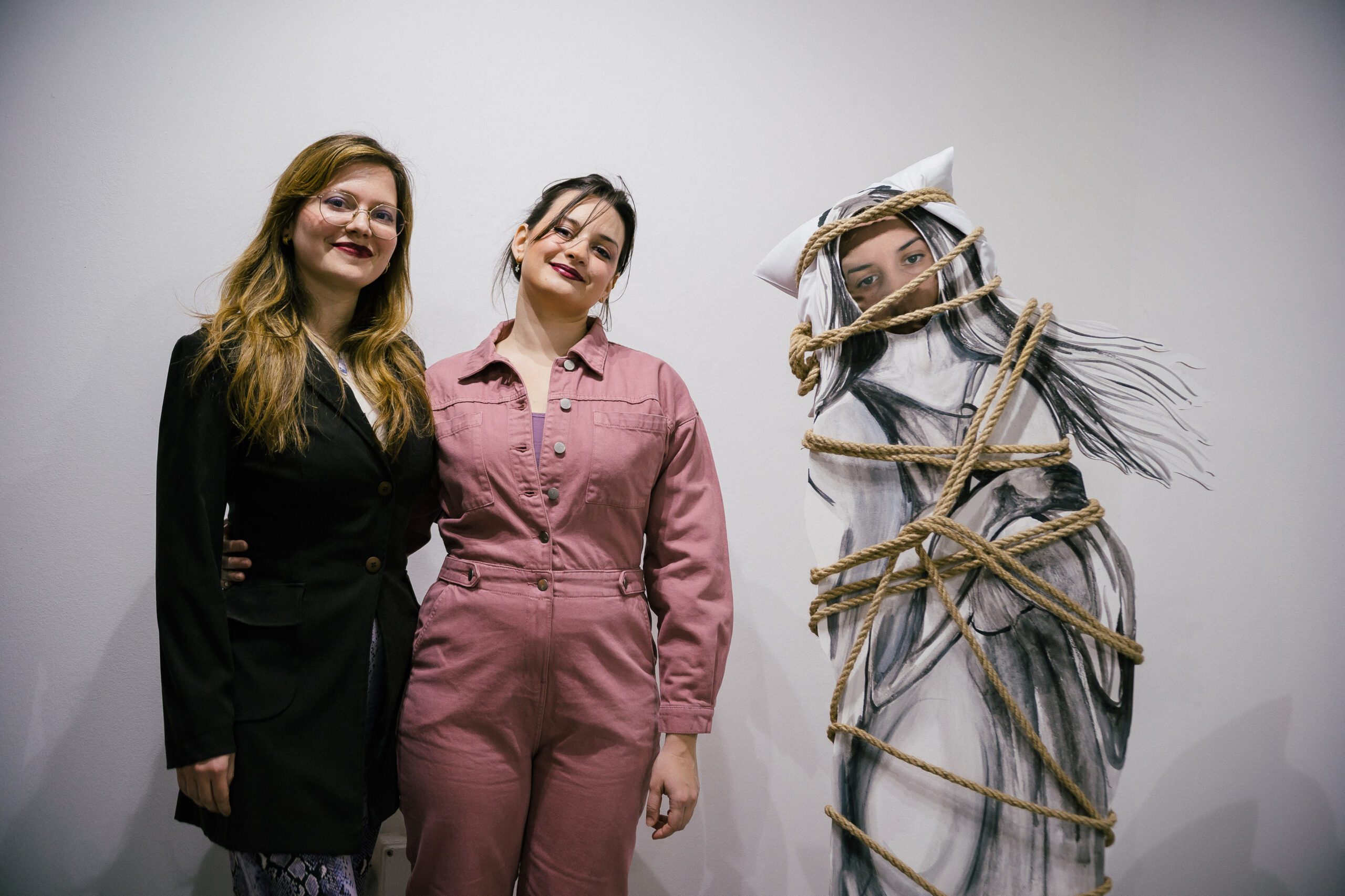
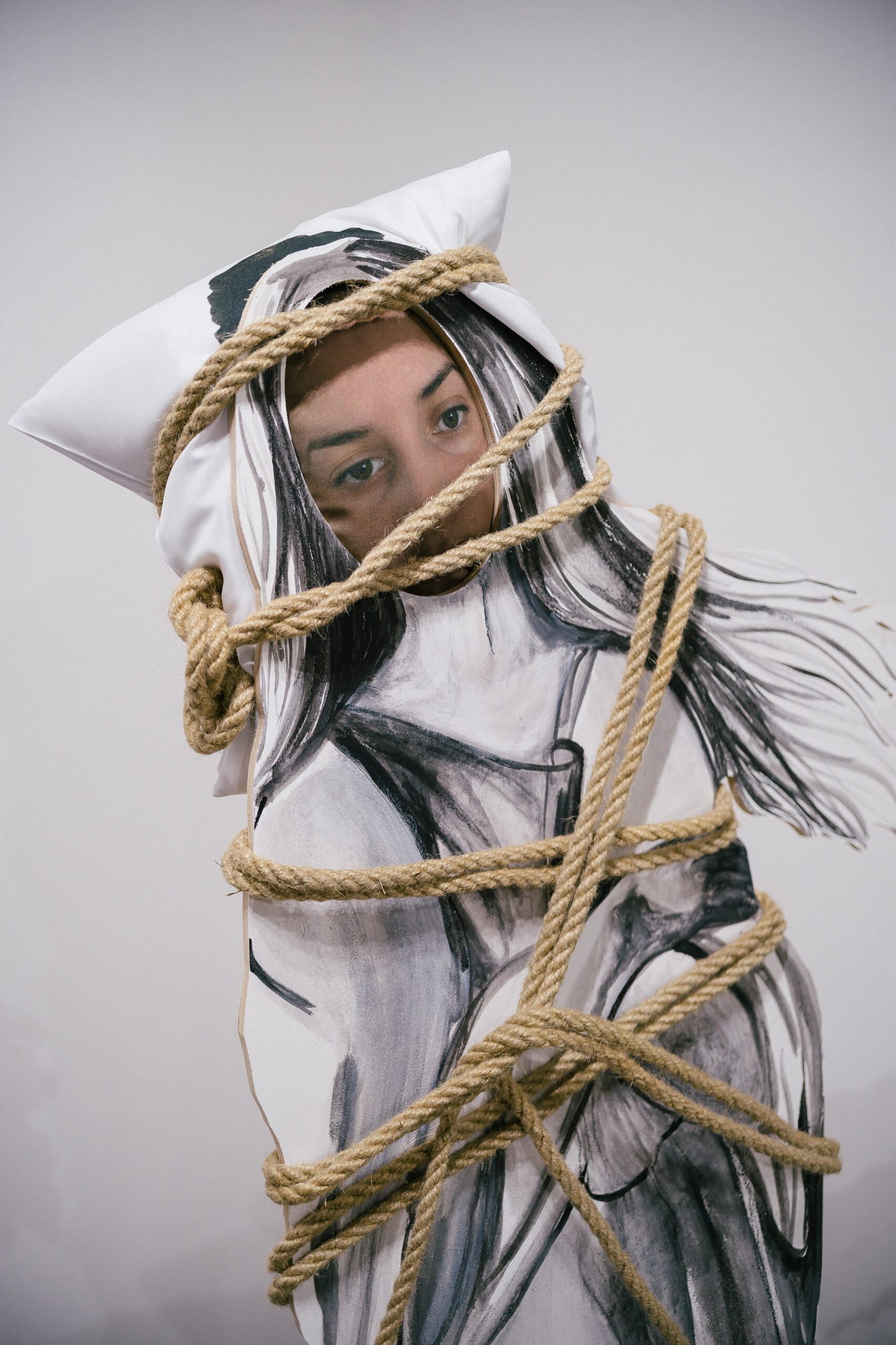
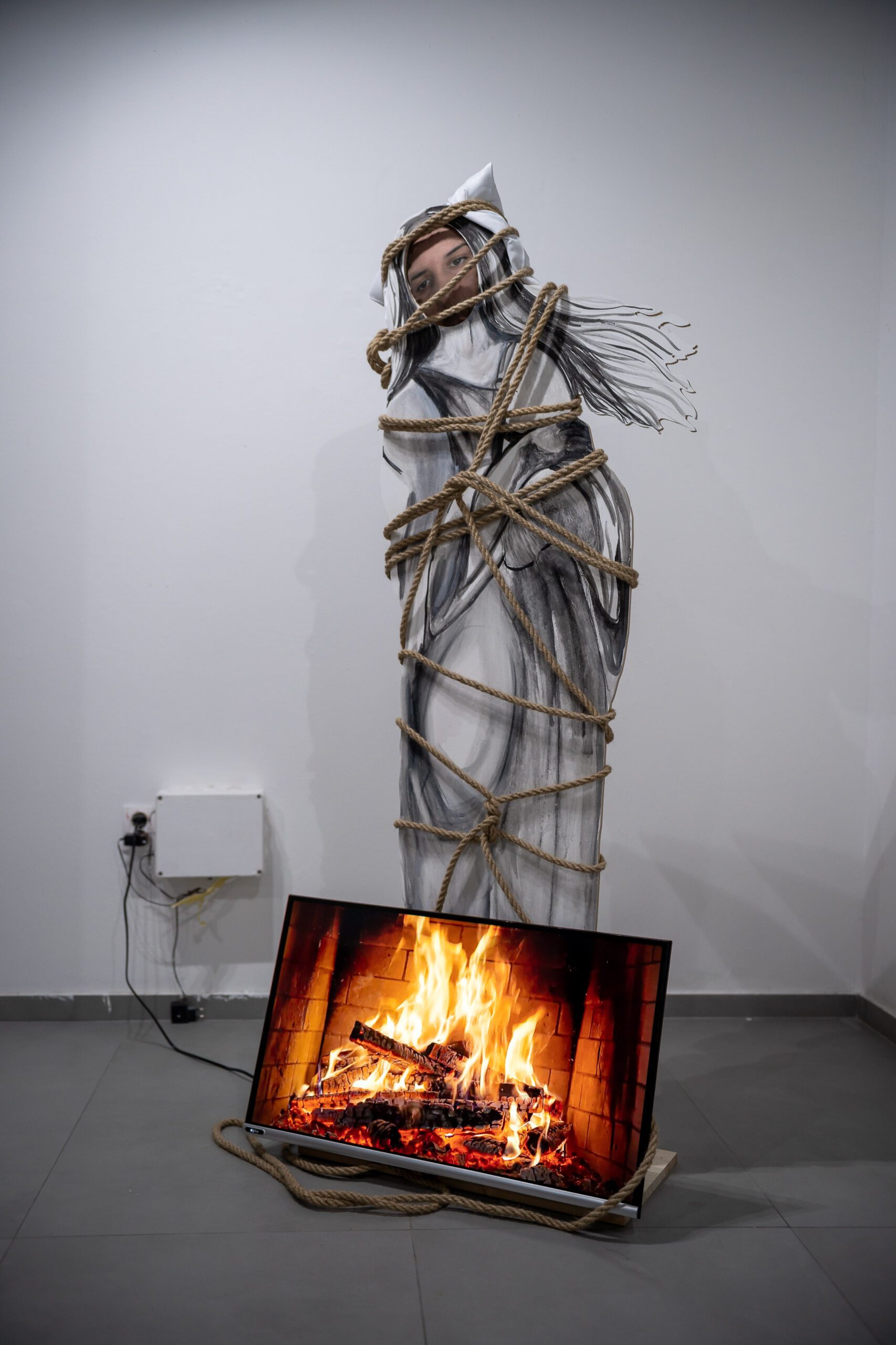
In the work *“I would rather die than sin”*, the artist situates herself in the context of Joan of Arc, a heroine who made large, dramatic decisions for freedom and rights, in contrast to the contemporary paralysis of micro-decisions that characterizes our society. How frightened are we of ourselves? To what extent do we intellectualize things to the point where it prevents us from acting? Jovašević argues that we turn ourselves into martyrs in situations far removed from the stake; most often, it is a performance of suffering, self-pity wrapped in the aesthetics of resistance.
Audre Lorde, in her work *“A Burst of Light”*, introduces something that would today become the concept of self-care, distorted and commodified in relation to its original context. “Caring for myself is not self-indulgence; it is self-preservation, and that is an act of political warfare.” Today, this idea, originally tied to techniques of resistance for both communities and individuals, and to caring for oneself as an act of defiance against capitalist pressure demanding constant productivity, has become part of a “treat yourself” culture.
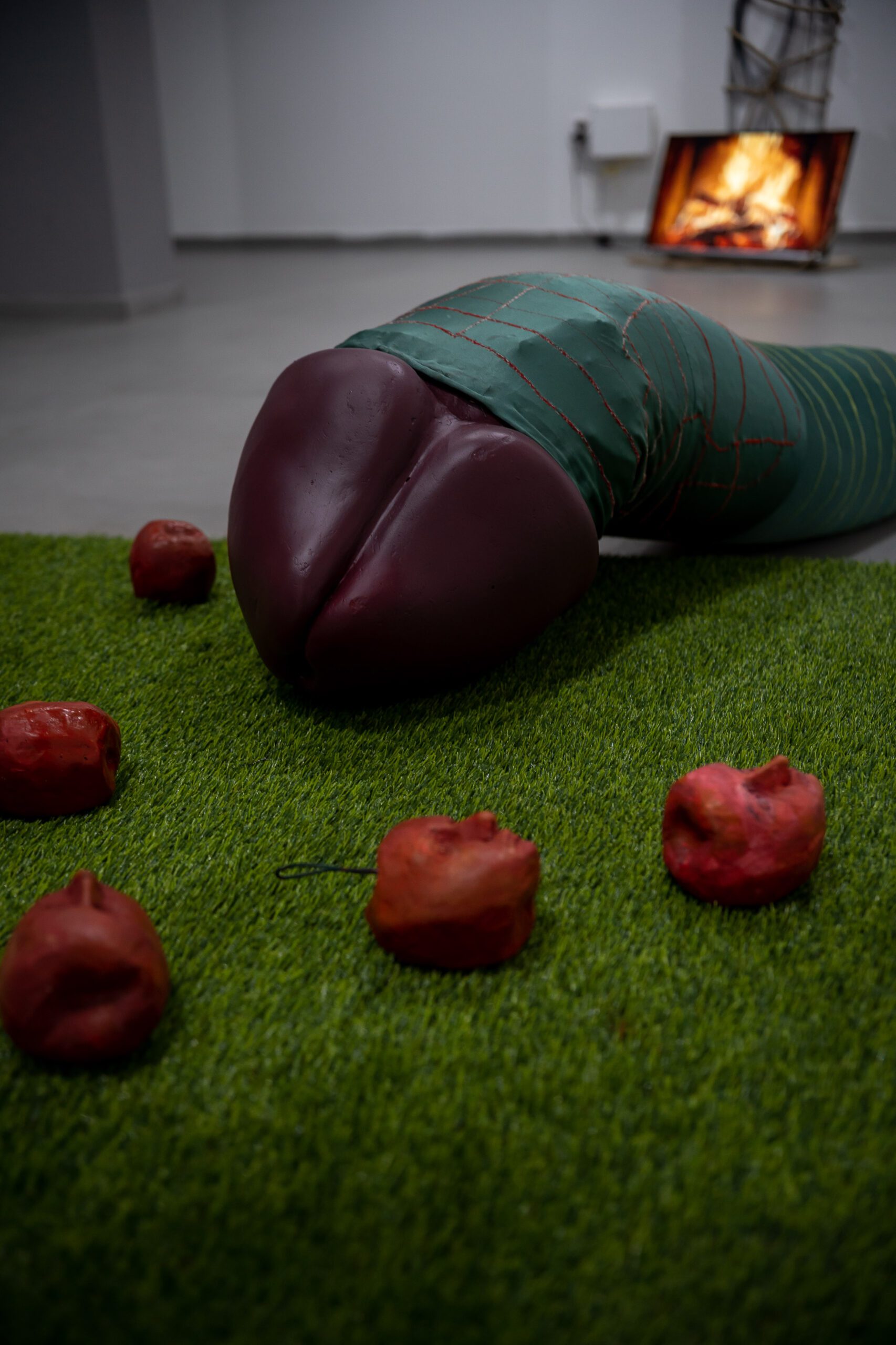
By buying a face mask and playing AI-generated lo-fi hip hop beats alongside fireplace videos, we try to calm our nervous system, while giving time and money to non-human systems that contributed to that very state.
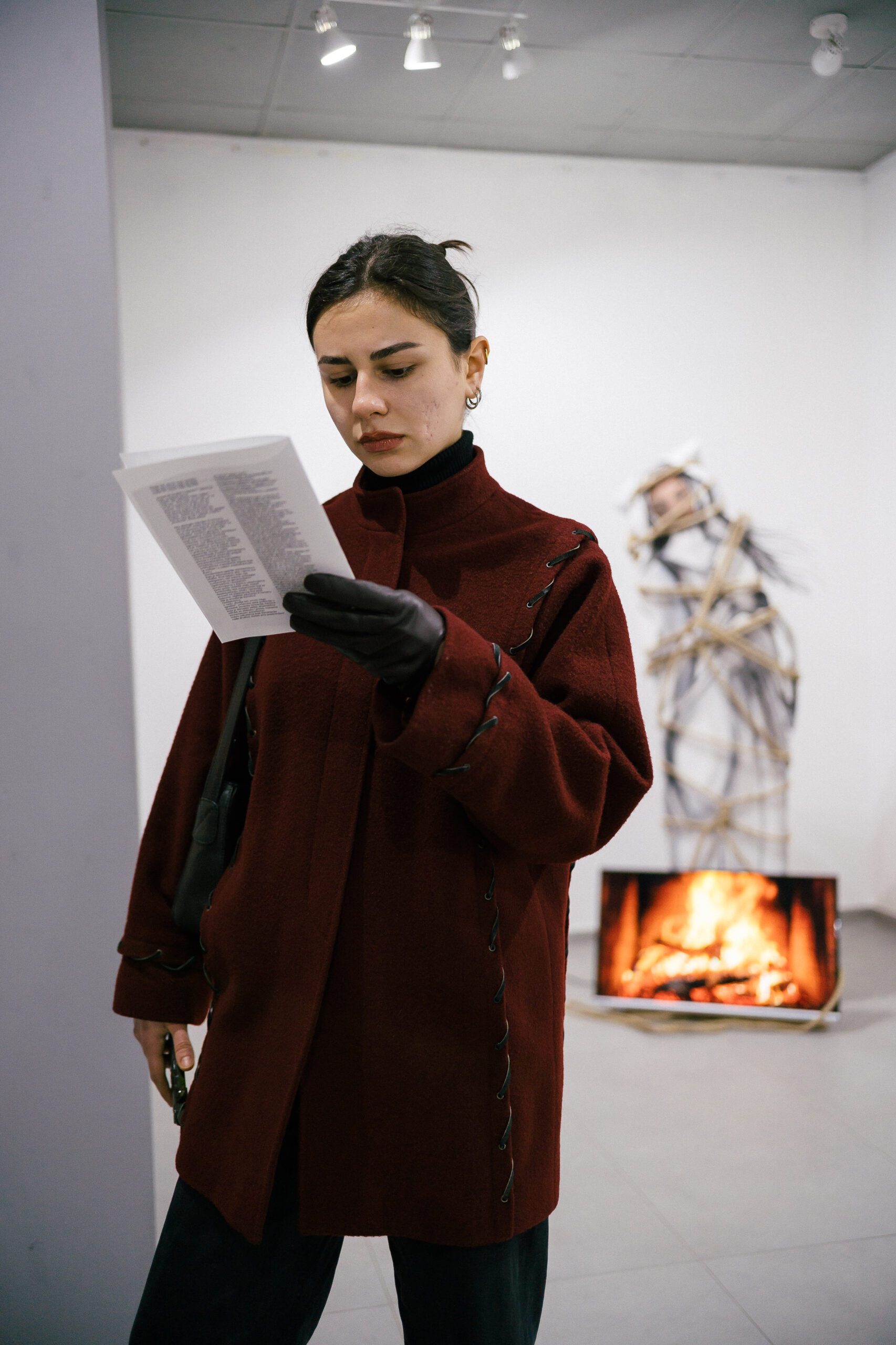
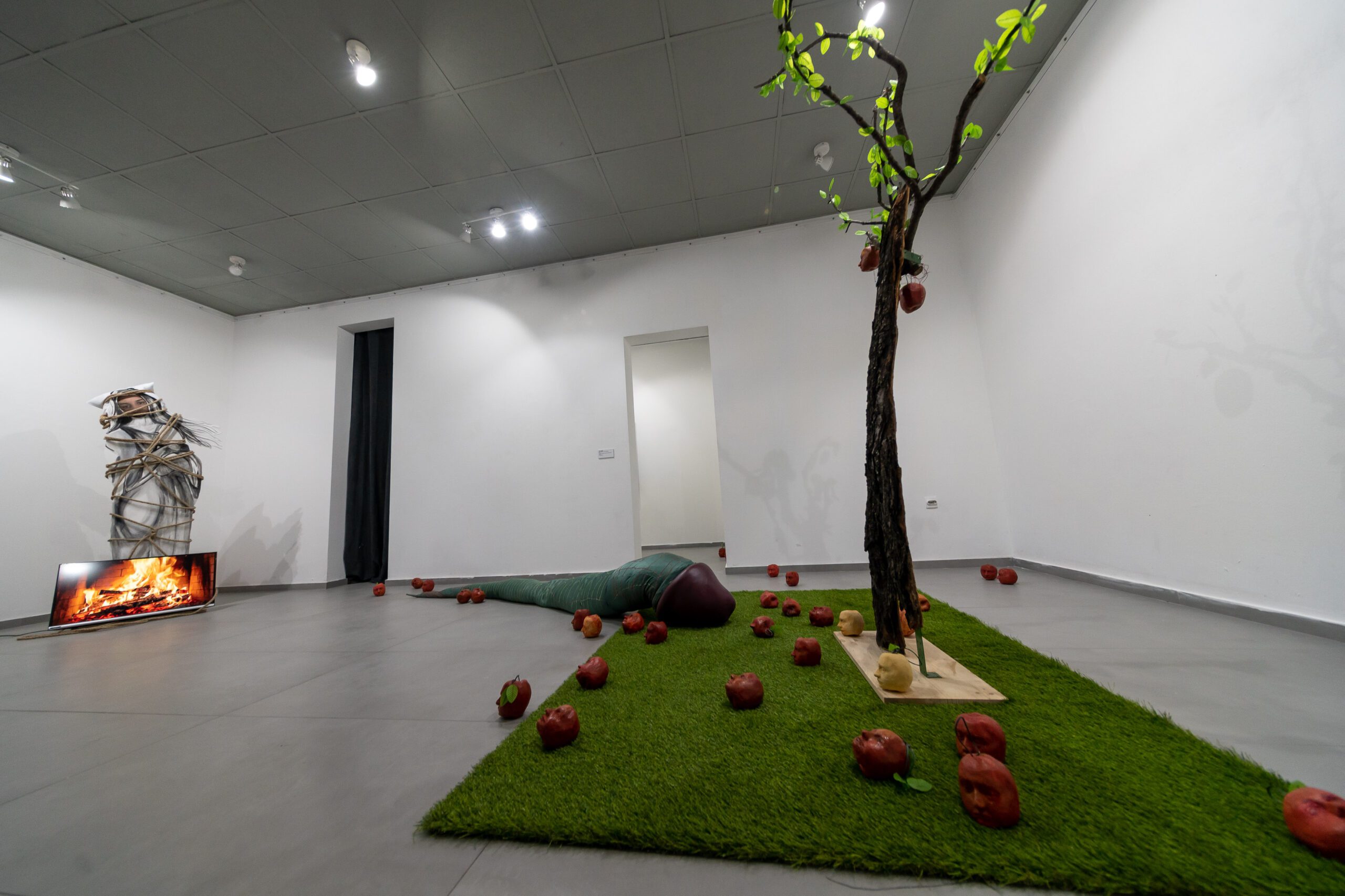
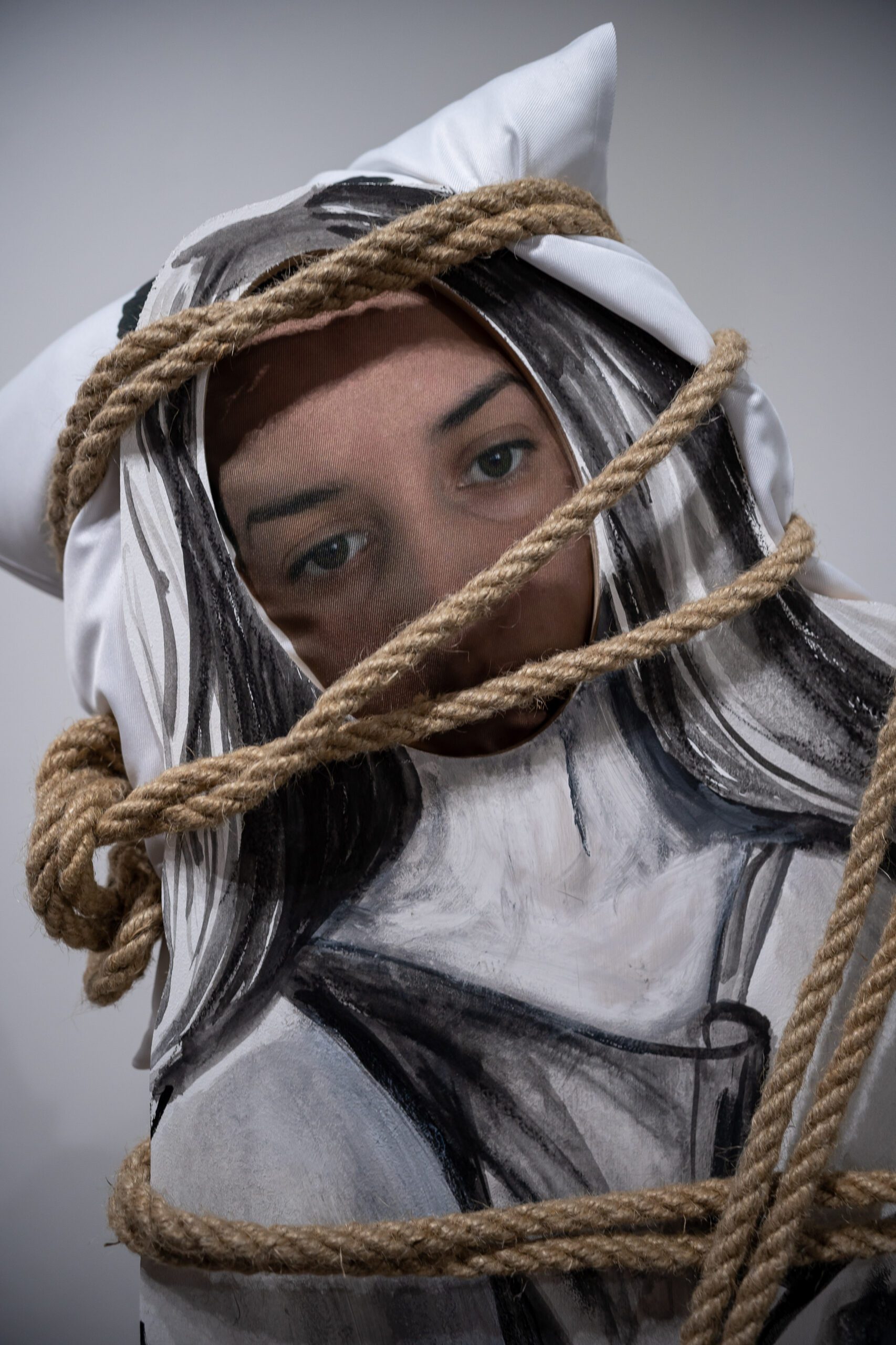
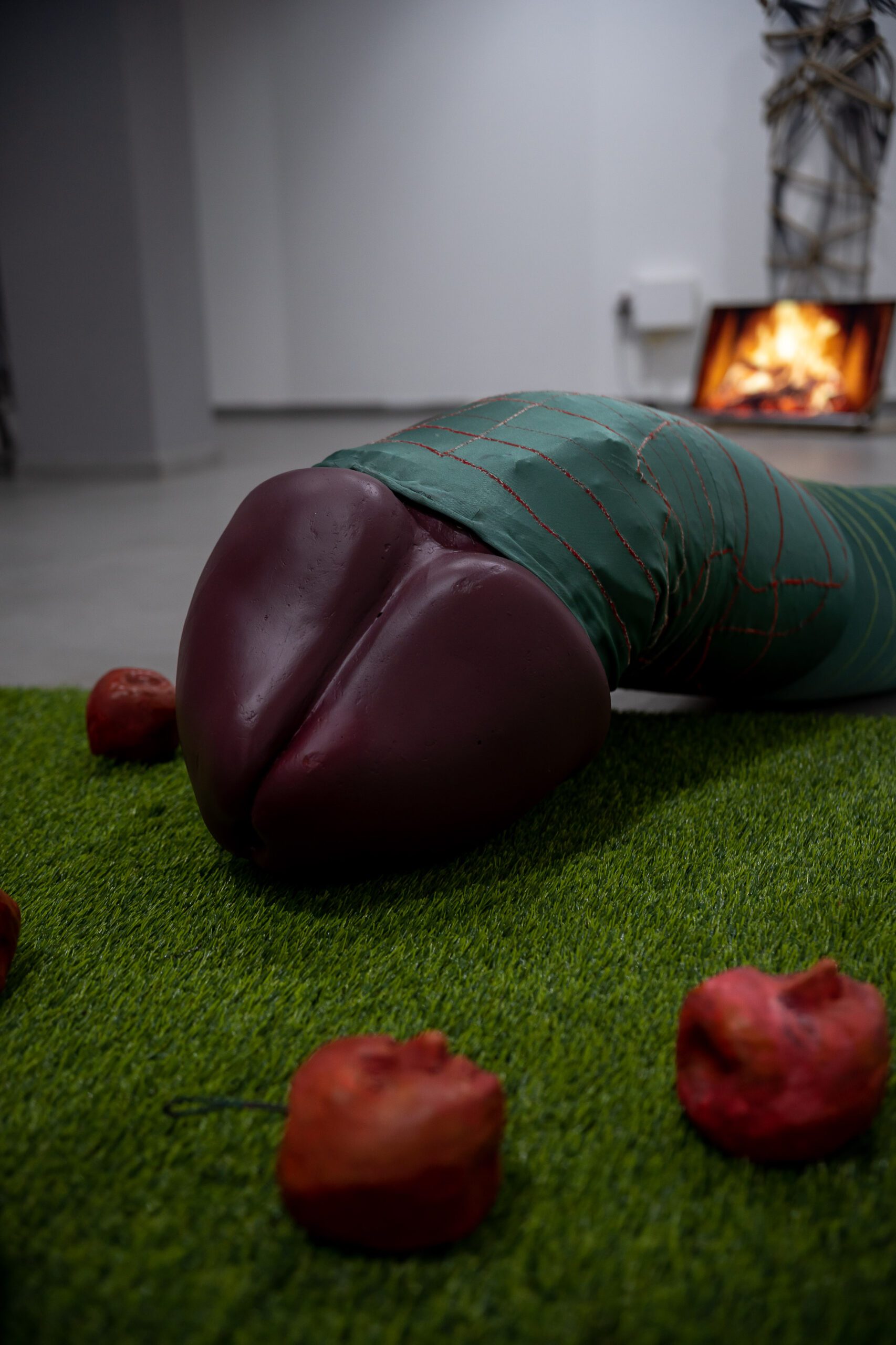
In her work *“I would rather die than sin”*, Jovašević selects the image of the well-known martyr Joan of Arc and places it in juxtaposition with a fireplace video, creating a dual association with her tragic suffering, but also with the artist’s portrait infiltrated into that situation, where there is no dramatic physical suffering, only an inability shaped by contemporaneity.
The artist does not choose calming through lo-fi aesthetics or minimalism, but rather through the artificiality of AI-generated images that suggest tranquility but never actually achieve it. This reveals another layer of irony: even when we seek comfort, we choose simulation over community.
Joan of Arc, as well as other sanctified virgin martyrs—Saint Agatha, Saint Lucy, Saint Barbara—who preferred chastity and death over lives filled with wealth and sex, were paradoxically seen as some of the most sexually alluring women in the Middle Ages, due to their beauty and their resistance to corporeality.
This ambiguous position, simultaneously an object of desire and a symbol of renunciation, aligns with the artist’s concept in which she de-sexualizes herself while placing her image in the position of a martyr. However, unlike medieval saints, her “stake” is a digital simulation, and her “martyrdom” is an ironic observational stance toward her own theatre of suffering, culminating in the statement “I would rather die than sin.”
This statement, on one hand, validates the archetype of the virgin martyr, and on the other, alludes to today’s fear of error through overthinking, which leads to an inability to act.
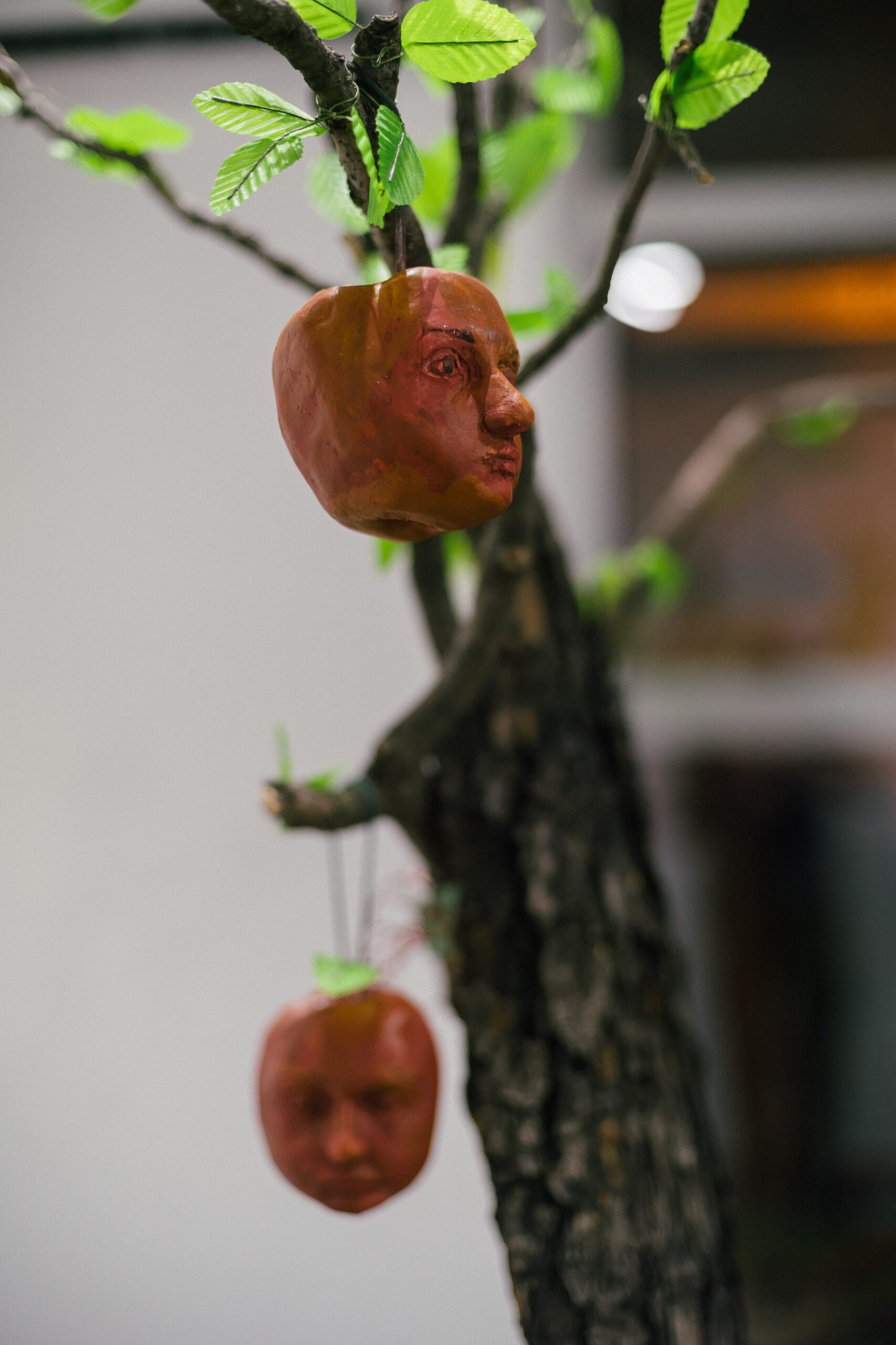
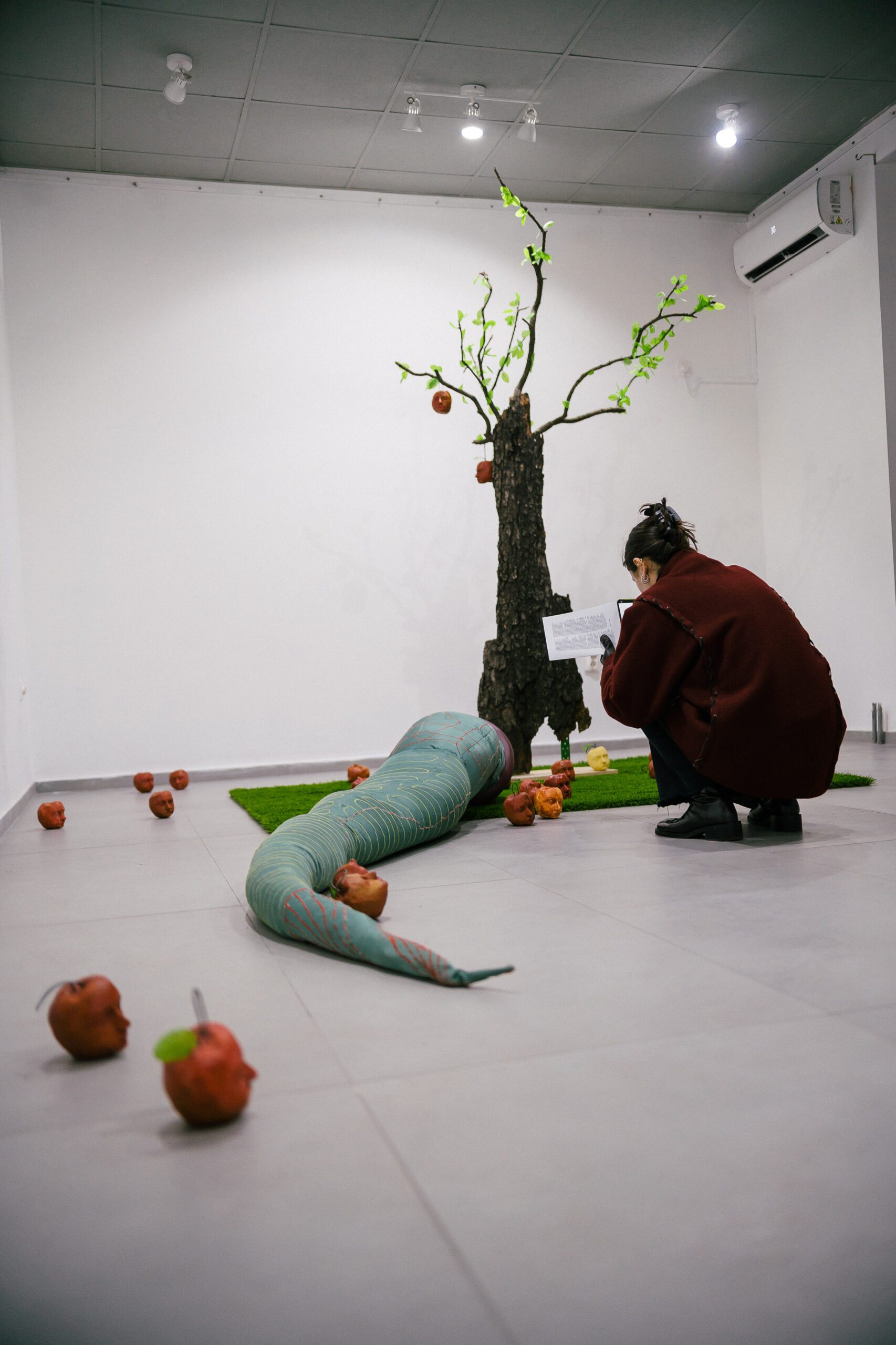
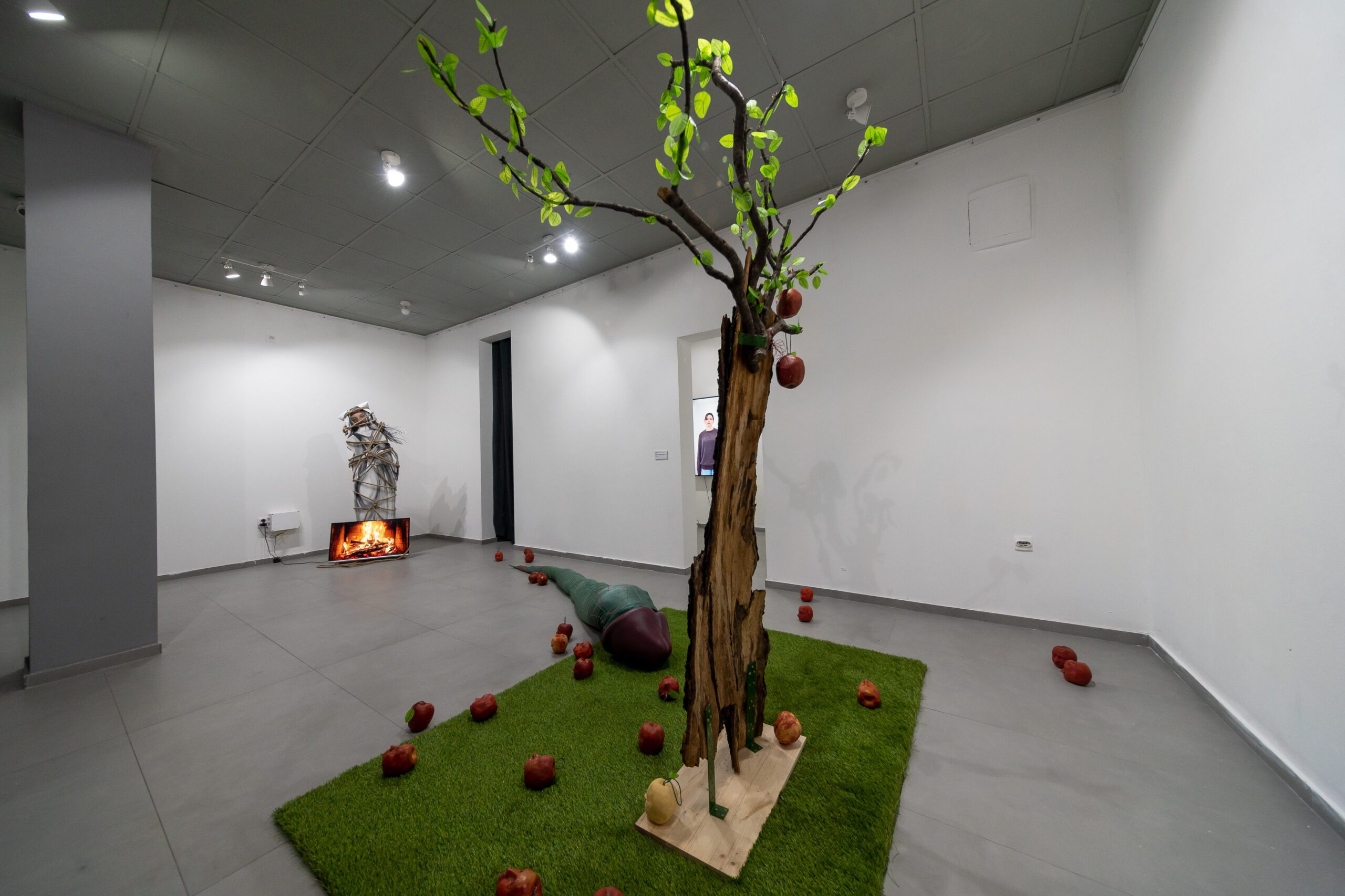
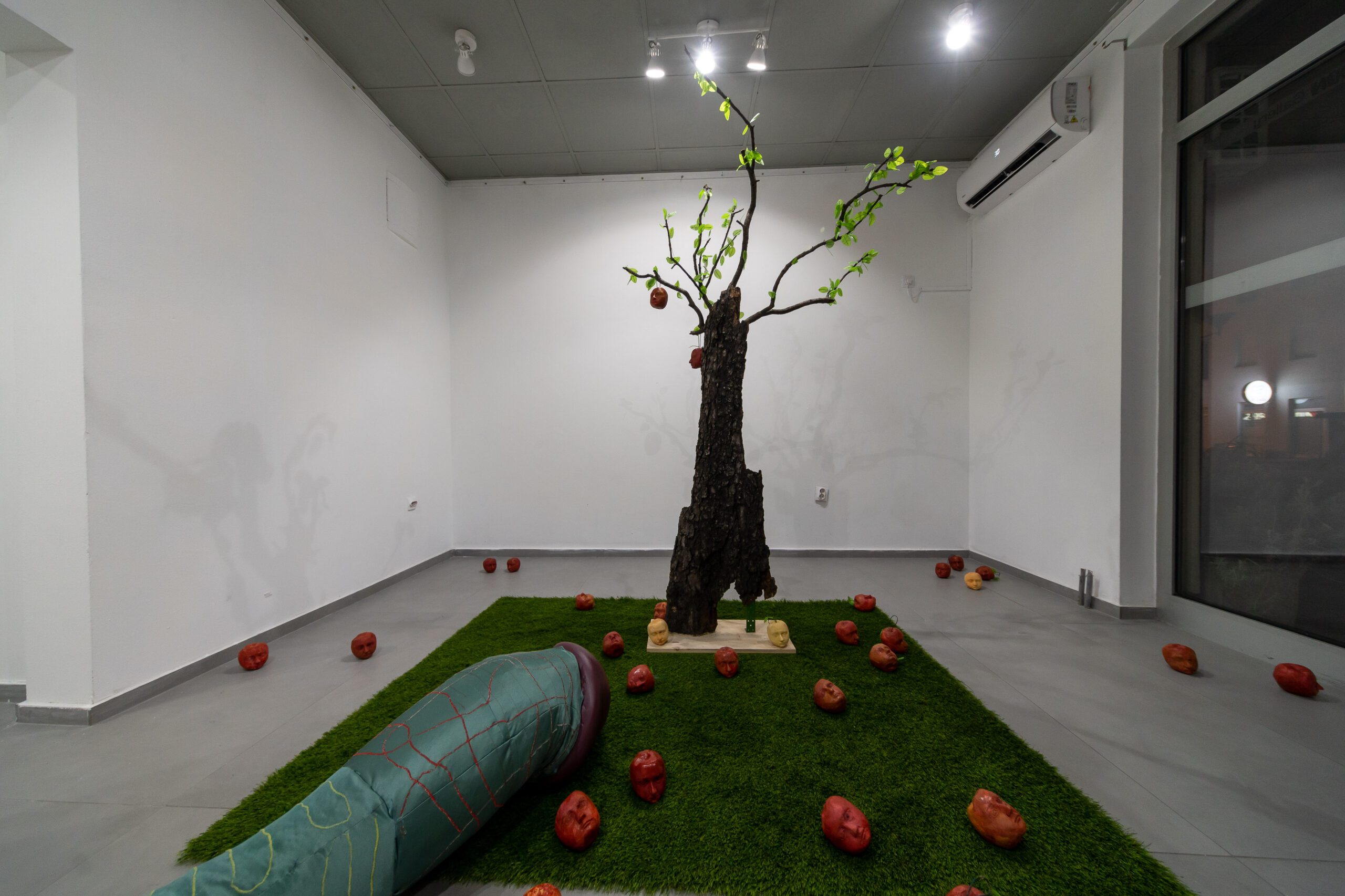
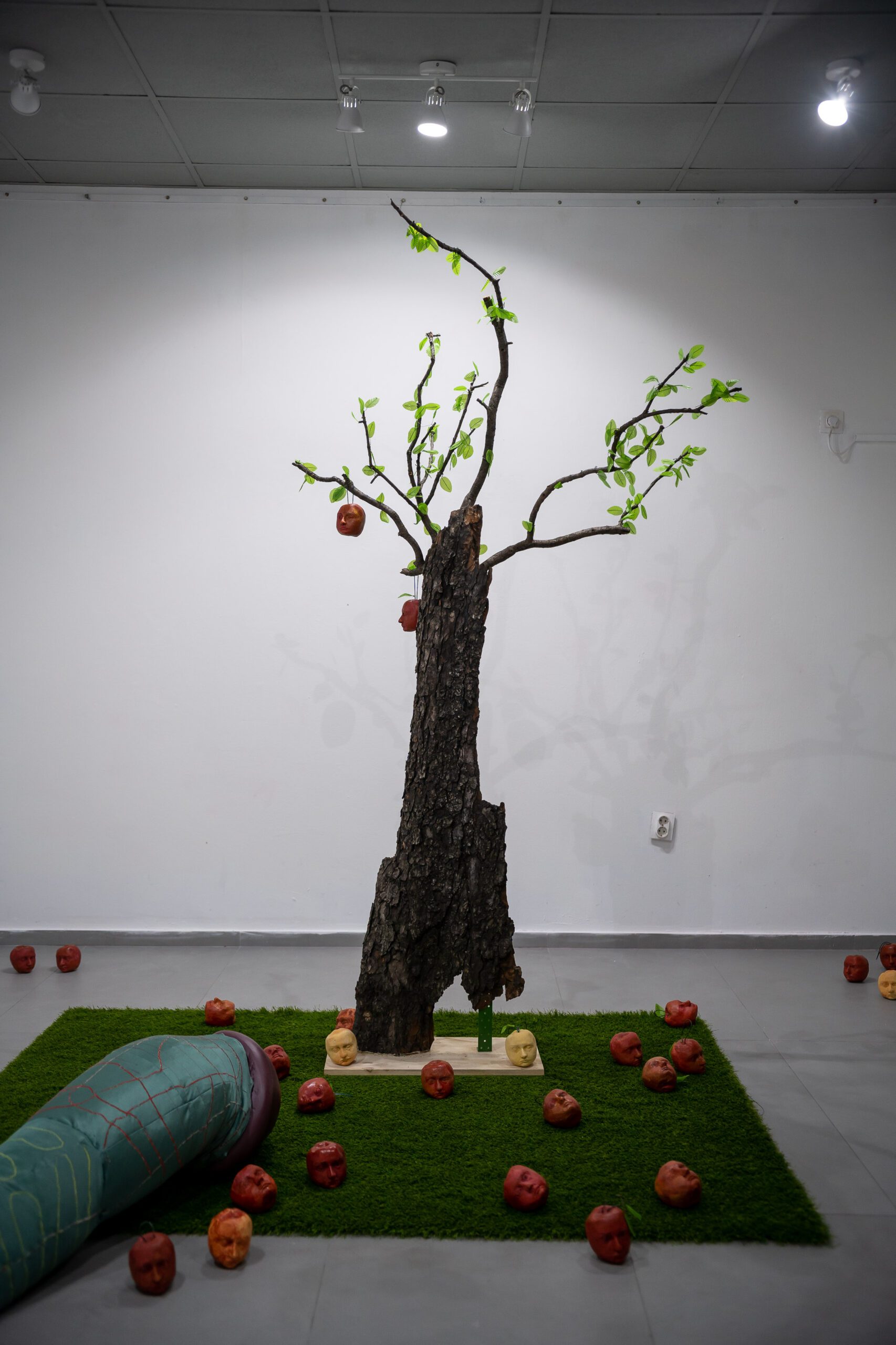
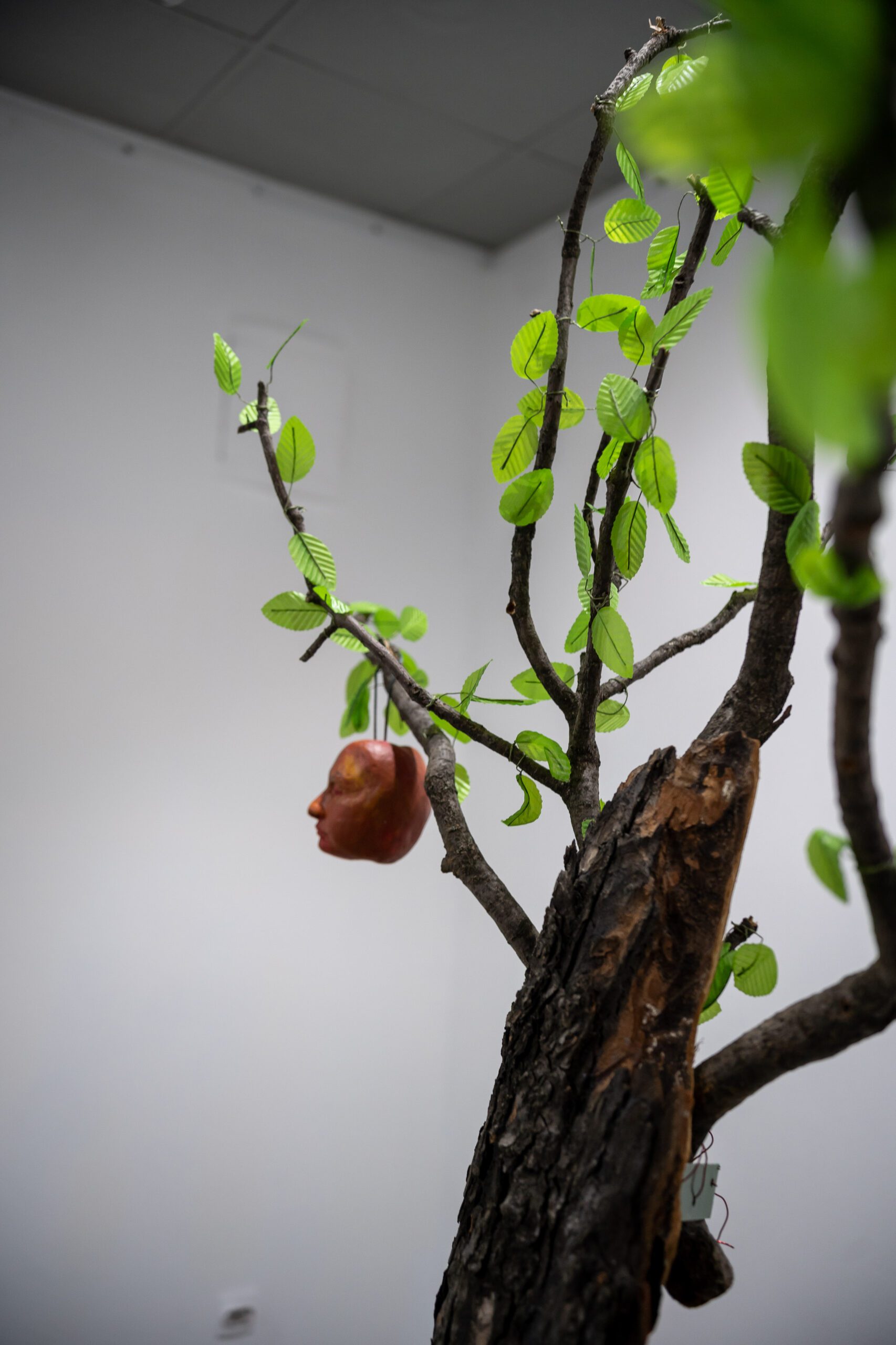
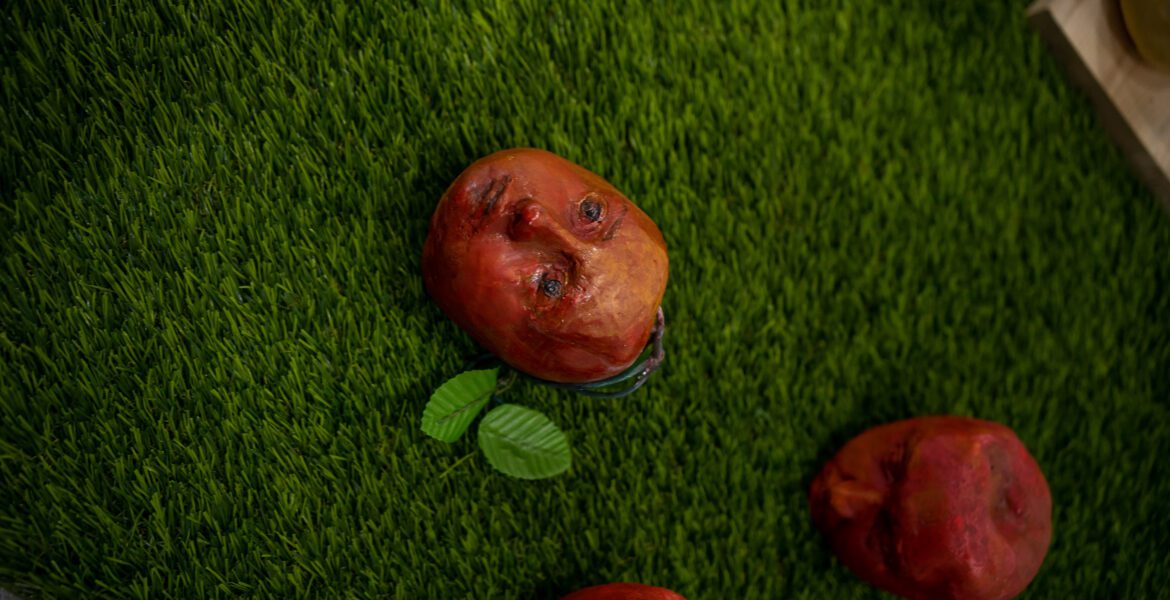
In the installation *“Tree of Knowledge,”* the artist continues this dialogue with the female body as a site of sin, temptation, and punishment. Inheriting a long tradition in which beauty was synonymous with virtue, Jovašević constructs an installation that renders this logic meaningless.
“As nature was understood as divine, those who were the most sacred and therefore closest to God were also in harmony with nature. Consequently, they were necessarily beautiful.” Within this logic, images of pre-Fall Eve were portraits of the most beautiful woman who could possibly exist.
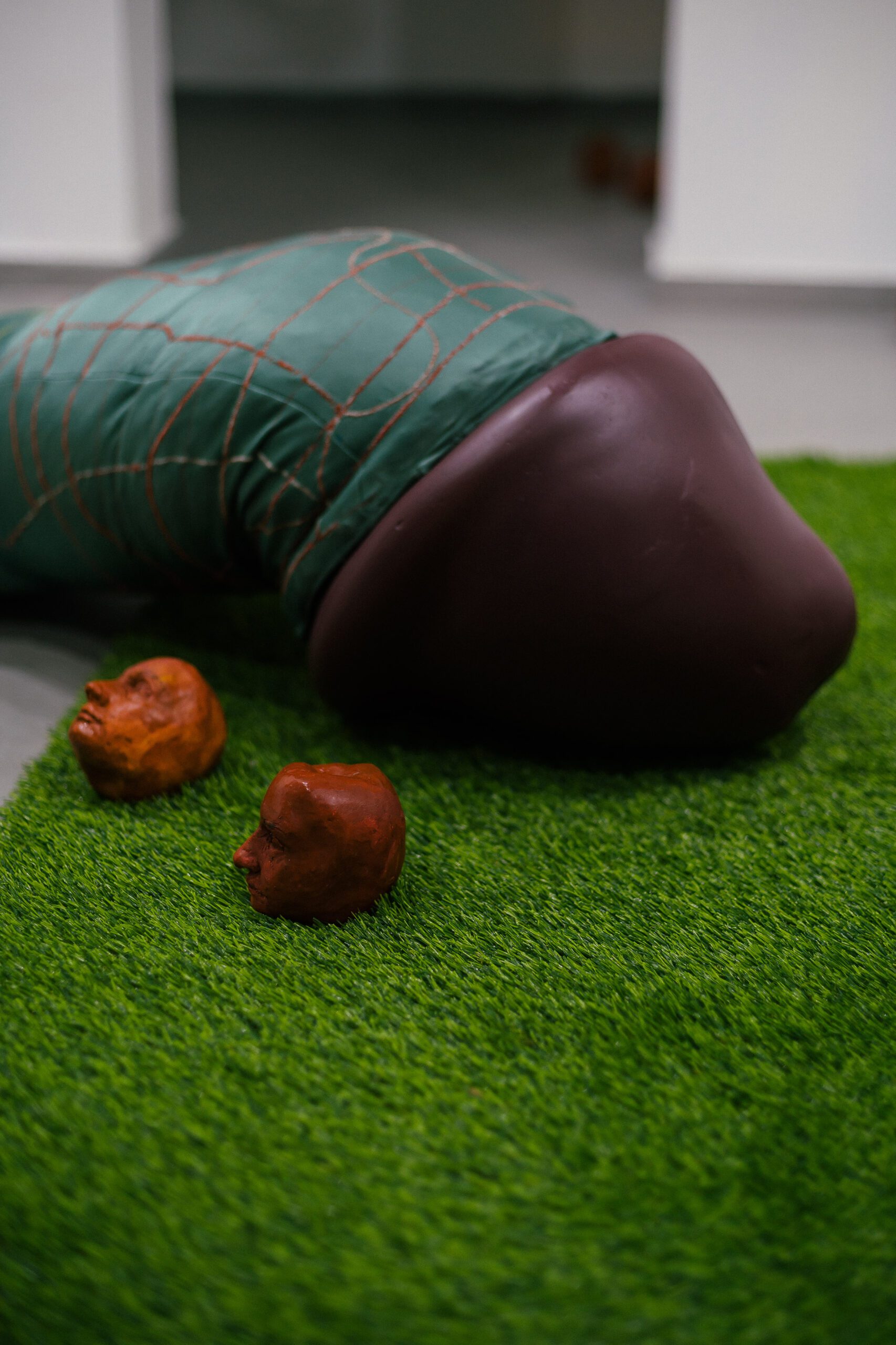
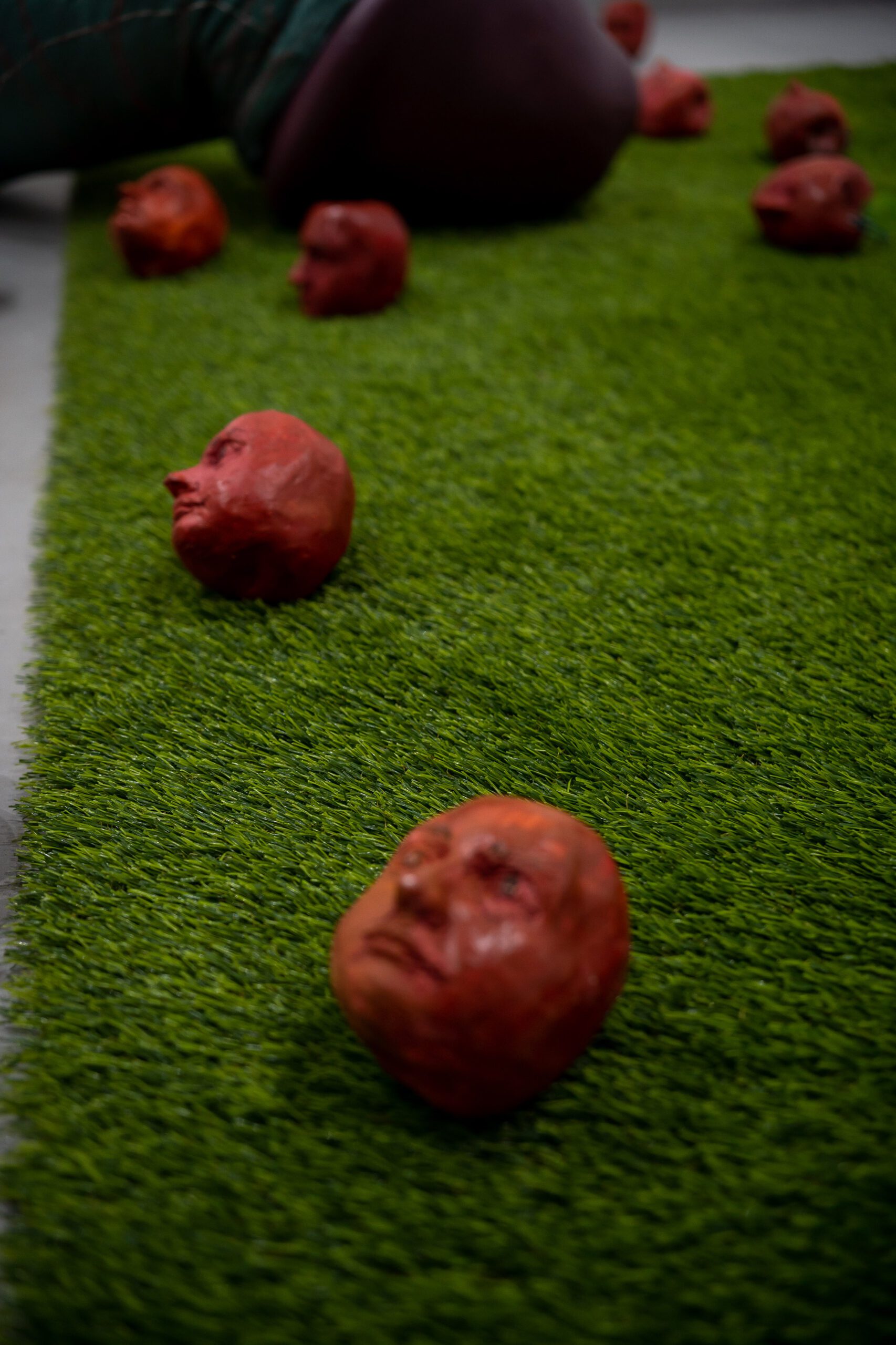
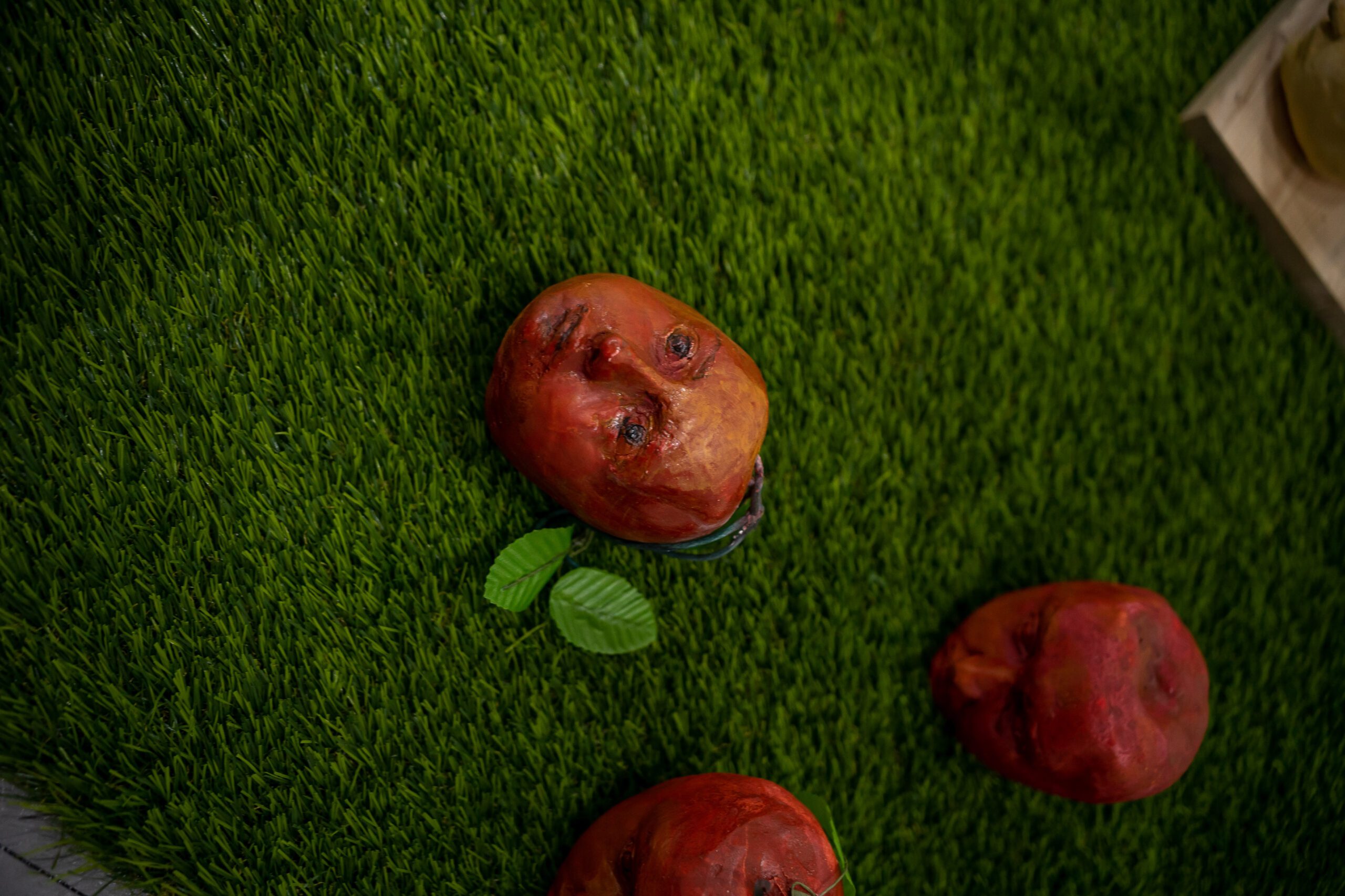
Jovašević appropriates this iconography but turns it into parody: the apples bear her own face, yet they are not fruits of harmony, but fruits that have fallen on their own and remain unpicked. Instead of an idealized Eve standing on the threshold of sin, we are given multiplied versions of the artist’s face, not as a beauty against which all other forms of beauty can be measured—while, of course, naked—but as discarded fruit.
This desexualization is a political act, precisely because it has almost always been acceptable to depict Eve nude and within a religious context, while control over the female body has always been mediated through aesthetics and religion. By placing her cast, her image, her likeness into the space of the installation instead of her body, she retains control over the narrative, but simultaneously acknowledges that objectification cannot be fully avoided, even in bodily absence.
The artist consciously avoids performance in the classical sense, because the presence of the body inevitably leads to objectification. Instead, she places representations of the figure into situations in which a living body would otherwise be, thereby inevitably controlling primary associations and the interpretation of the work.
The processual nature of her work does not stem from conceptual rigor, but from the need to materialize what otherwise remains in a zone of discomfort—the pleasant-unpleasant territory where one simultaneously speaks ill of oneself and constructs a narrative about oneself.
The work *“Tree of Knowledge,”* created in collaboration with Katarina Bošković, further complicates these themes through questions of authorship and collective creation. Apples bearing the artist’s face, a snake-phallus as the crown of a monumental parody, and artificial materials that emphasize the context and conditions in which the artist works—all of this speaks to positioning within the contemporary art system, but also to how transgression itself can appear contingent, accidental, even comic.
As part of the exhibition “I Would Rather Die Than Sin,” Jana Jovašević’s works do not offer catharsis; instead, they ask us to what extent our defense mechanisms serve protection, and to what extent they paralyze us. How much does resistance differ from the rigid conventions we are fighting against? And most importantly, are you ready to laugh at yourself, or do you still think you are at the stake?
It is precisely in that uncertainty, in the space between self-contempt and self-irony, between paralysis and action, between Eve before the Fall and Eve after, that Jovašević constructs her work, using cheap materials, visible seams, casts of her own face, and simulations of calm.
Because if we cannot avoid suffering, we can at least stop taking it so seriously. We can recognize that our sins are small, our stakes are digital, and our martyrdom voluntary. Jovašević does not offer us refrigerium, but humor as a way of surviving, lightness as resistance, and an apple that is not forbidden, but perhaps… unnecessary.
Text: Jovana Trifuljesko
Jana Jovašević (1995, Ivanjica) completed her undergraduate (2022) and master’s studies (2024) at the Sculpture Department of the Faculty of Fine Arts in Belgrade, where she is currently pursuing doctoral artistic studies. During
2023–2024, she studied at the École nationale supérieure des Beaux-Arts in Paris through the Erasmus+ program. She was awarded the Vladeta Petrić Sculptor Prize in early 2025.
Her recent exhibitions include *Palimpsests* (Gallery 73, Belgrade, 2024), *Sex and Politics* (BL Art Festival, Banja Luka, 2024), *Pseudoshadows* (U10, Belgrade, 2024), and *Attitudes and Forms* (Museum of Contemporary Art of Vojvodina, Novi Sad, 2023). In 2023, she also presented solo exhibitions *Satisfaction* (Gallery Kornjača, Belgrade) and *Pleasure is All Mine* (Šok Zadruga, Novi Sad), as well as participated in *Playground* (Earl Lu Gallery, Singapore), *Blue Exhibition* (Museum of Contemporary Art, Belgrade), and *Masterpieces V* (U10, Belgrade).
She took part in several student exhibitions at the Belgrade Youth Center and exhibited at major events such as Sculptors of Serbia (Cvijeta Zuzorić Pavilion, 2022). Her early exhibitions include *Festum21* (SKC, Belgrade, 2021) and *First Time Exhibiting* (Jevevrem Grujić House, 2021). She participated in the international residency Tropical Lab 17 at LASALLE College of the Arts in Singapore in 2023. Since 2024, she has been a member of the U10 Art Collective in Belgrade. Since 2025, she has been employed as a research trainee at the Sculpture Department of the Faculty of Fine Arts.