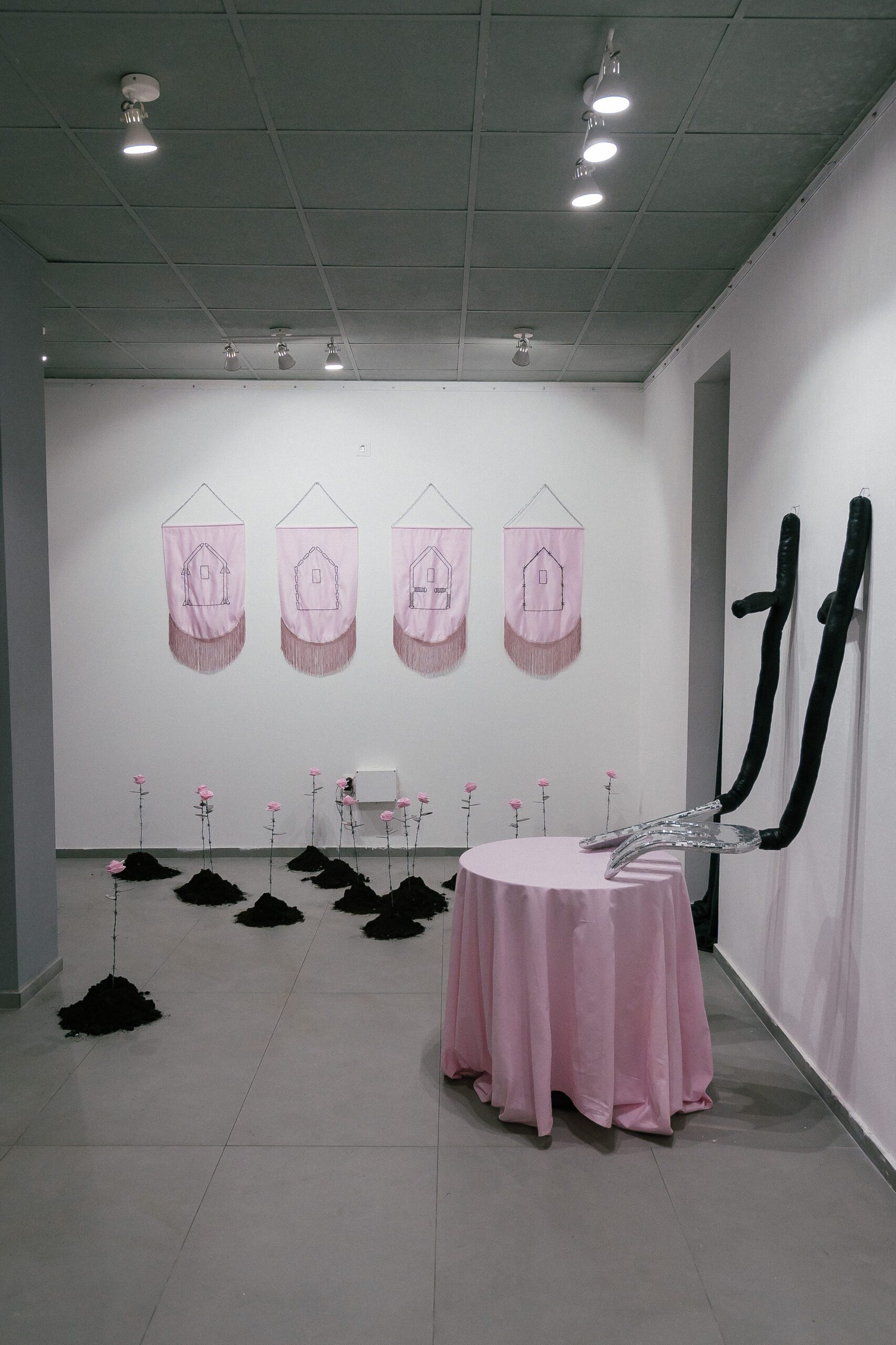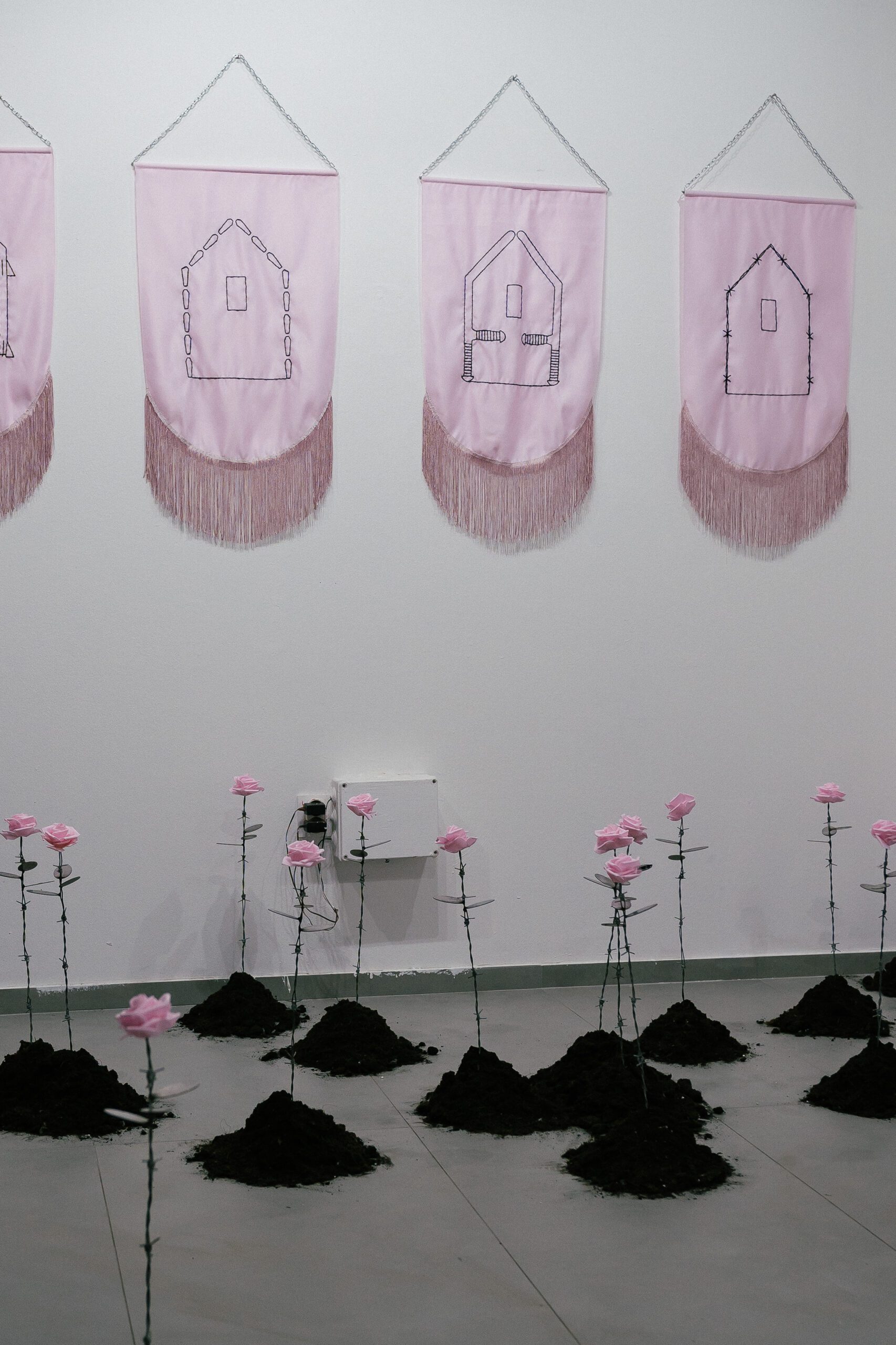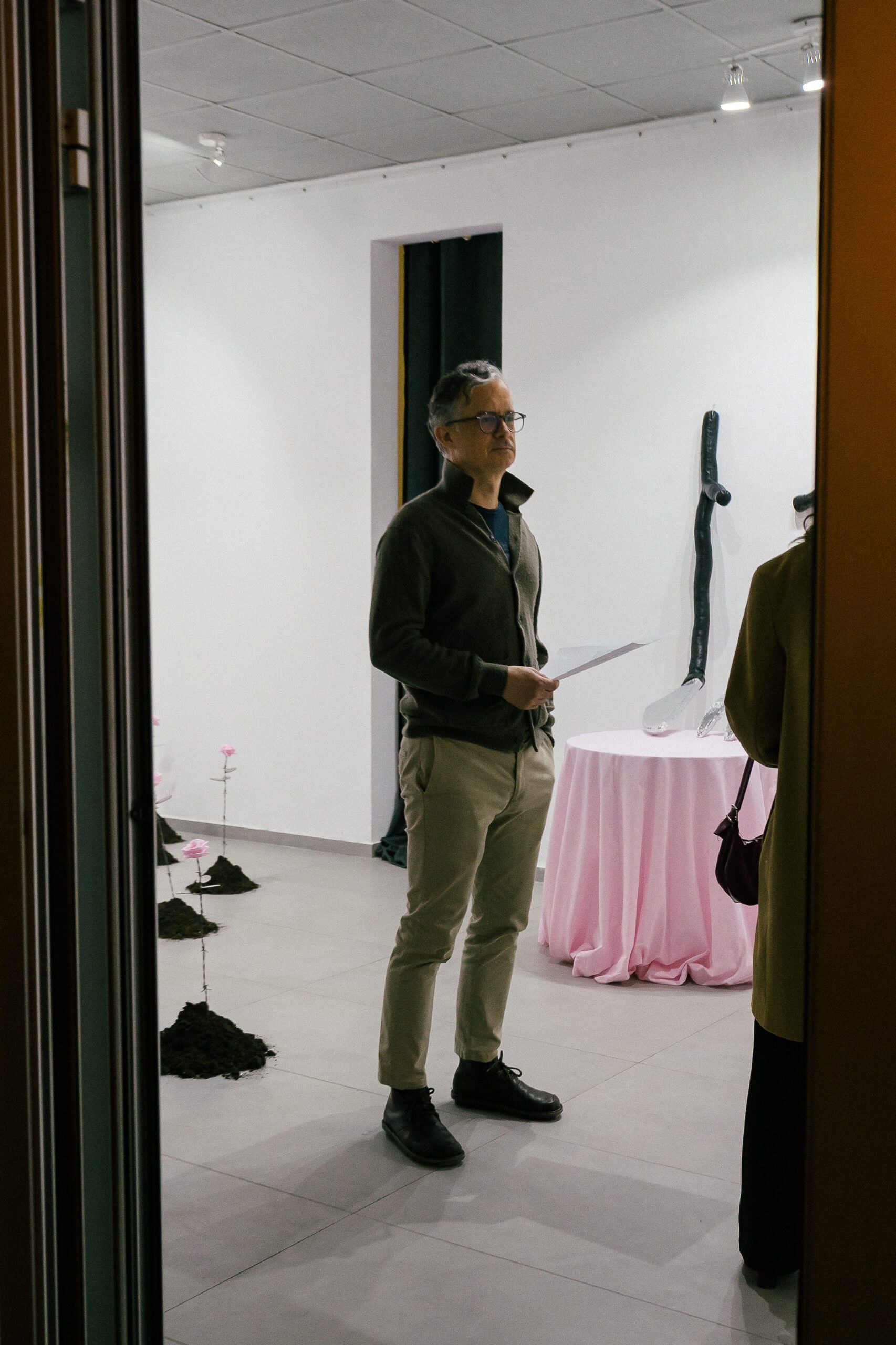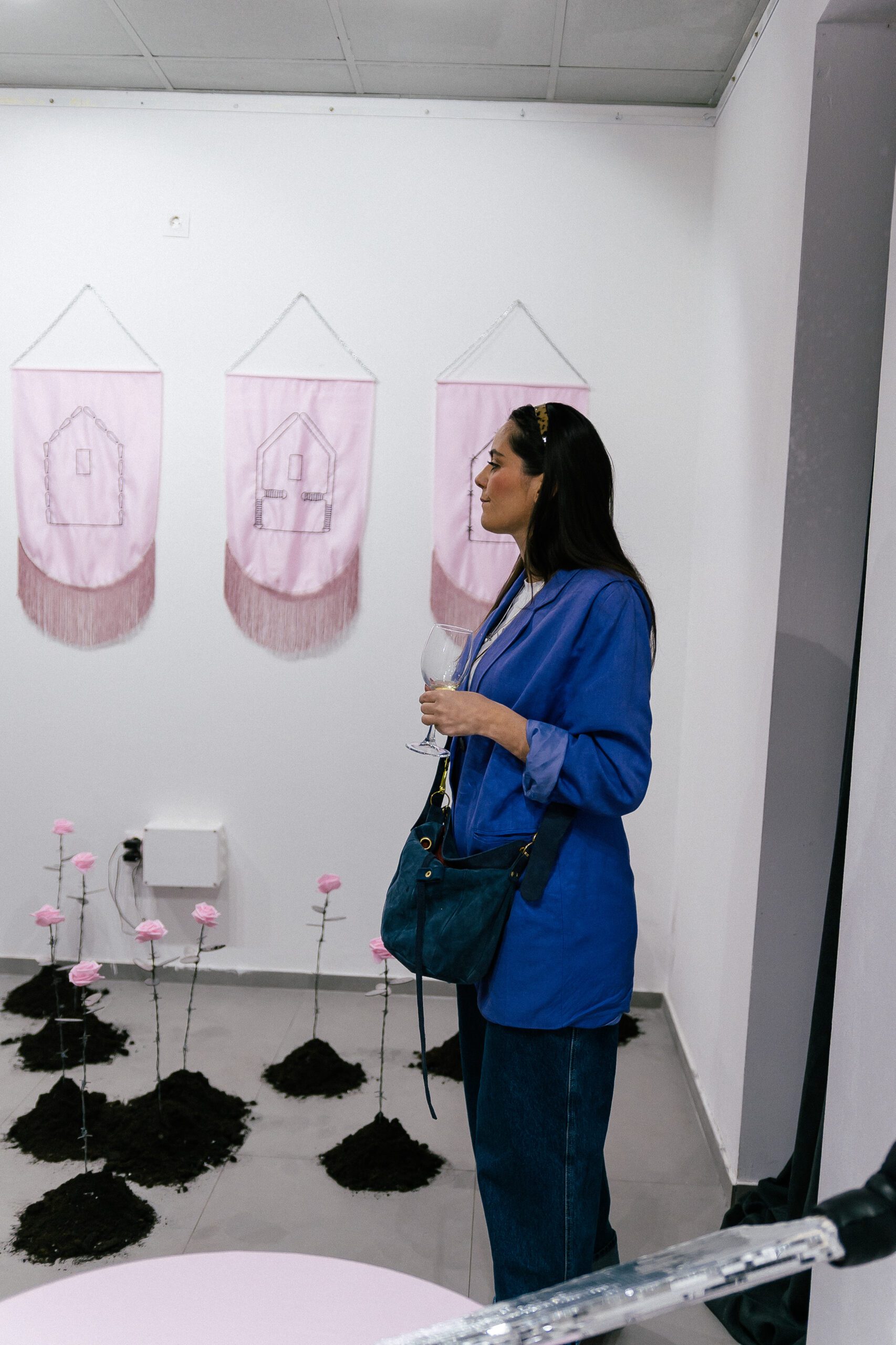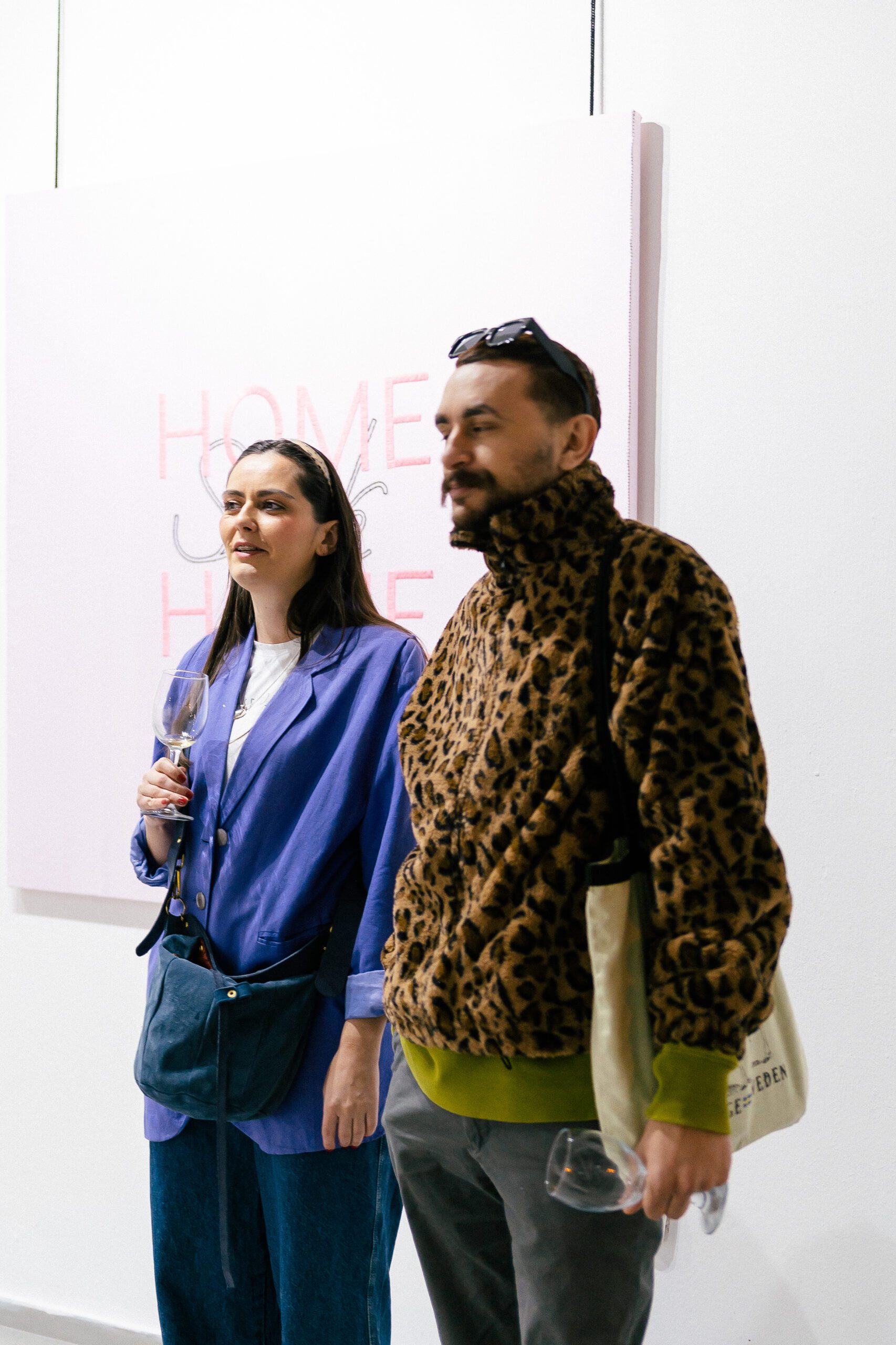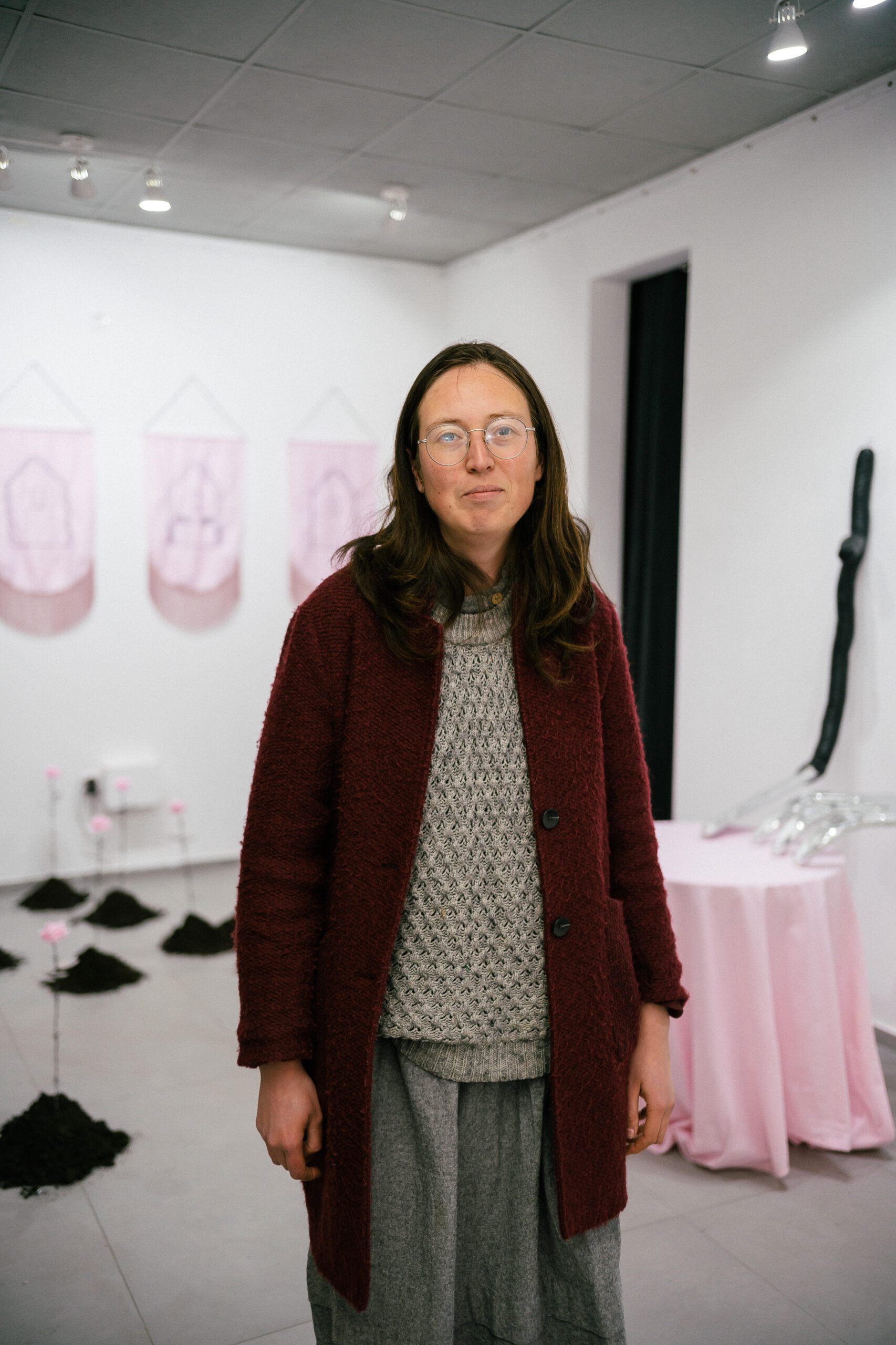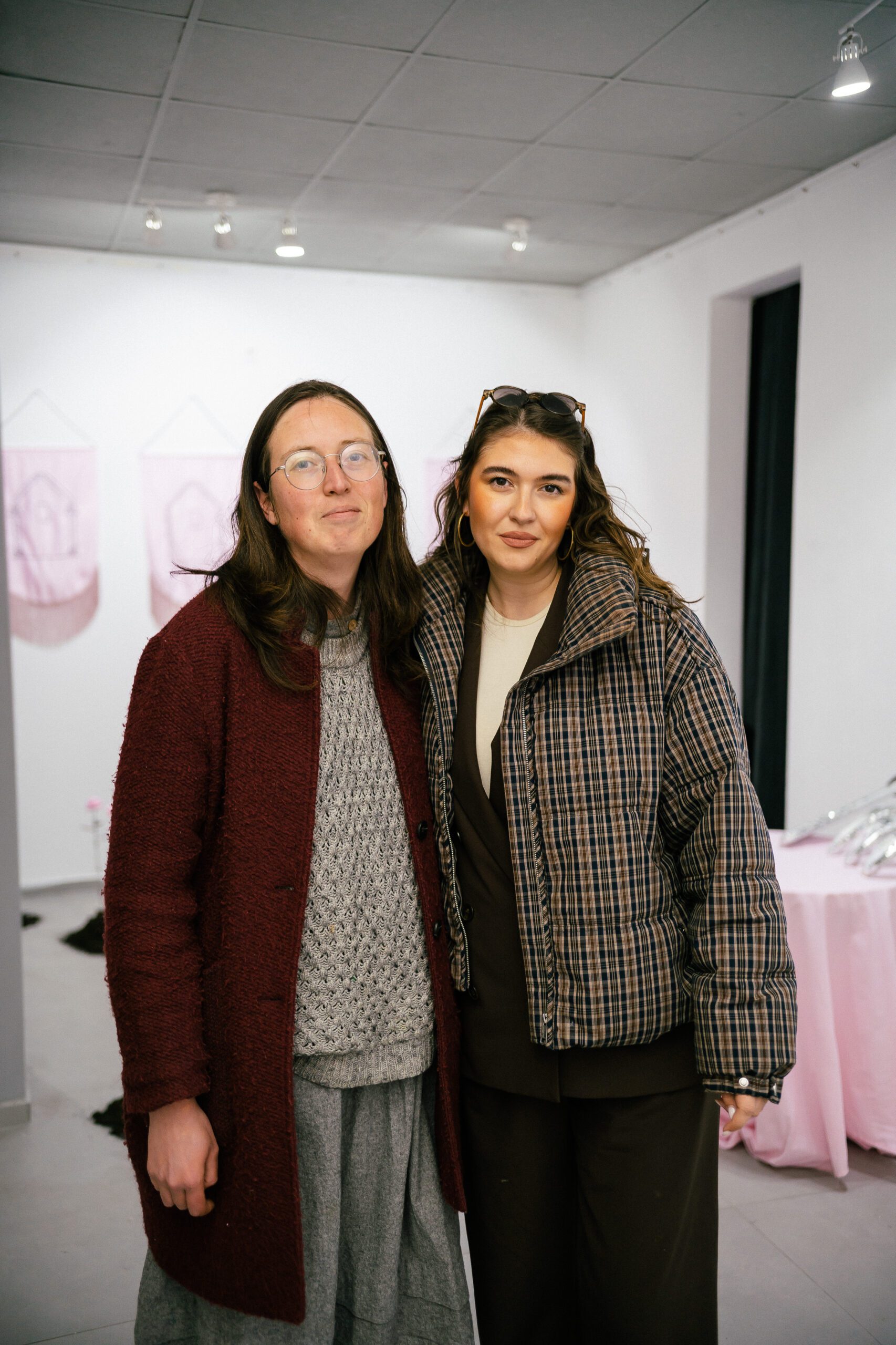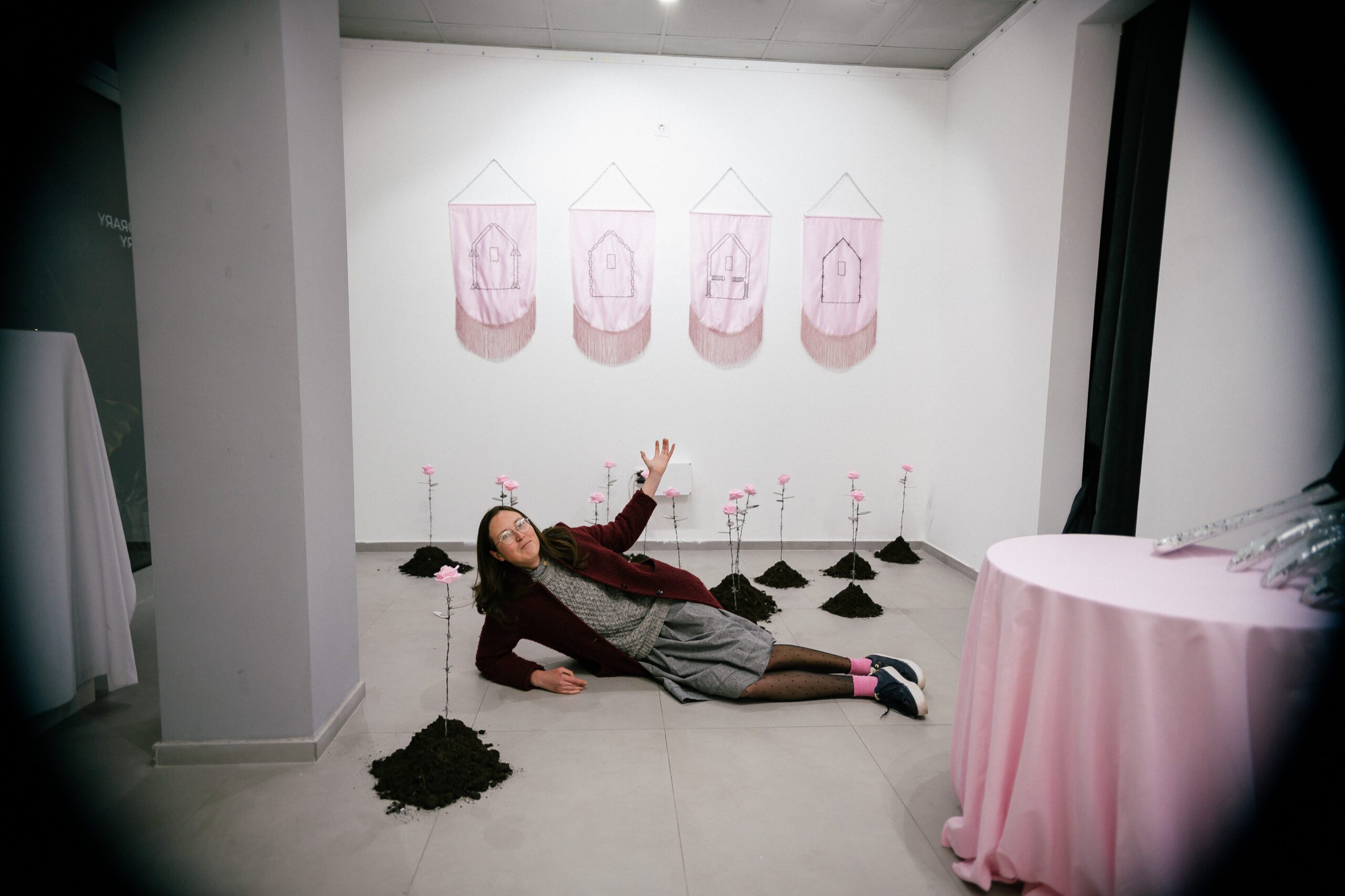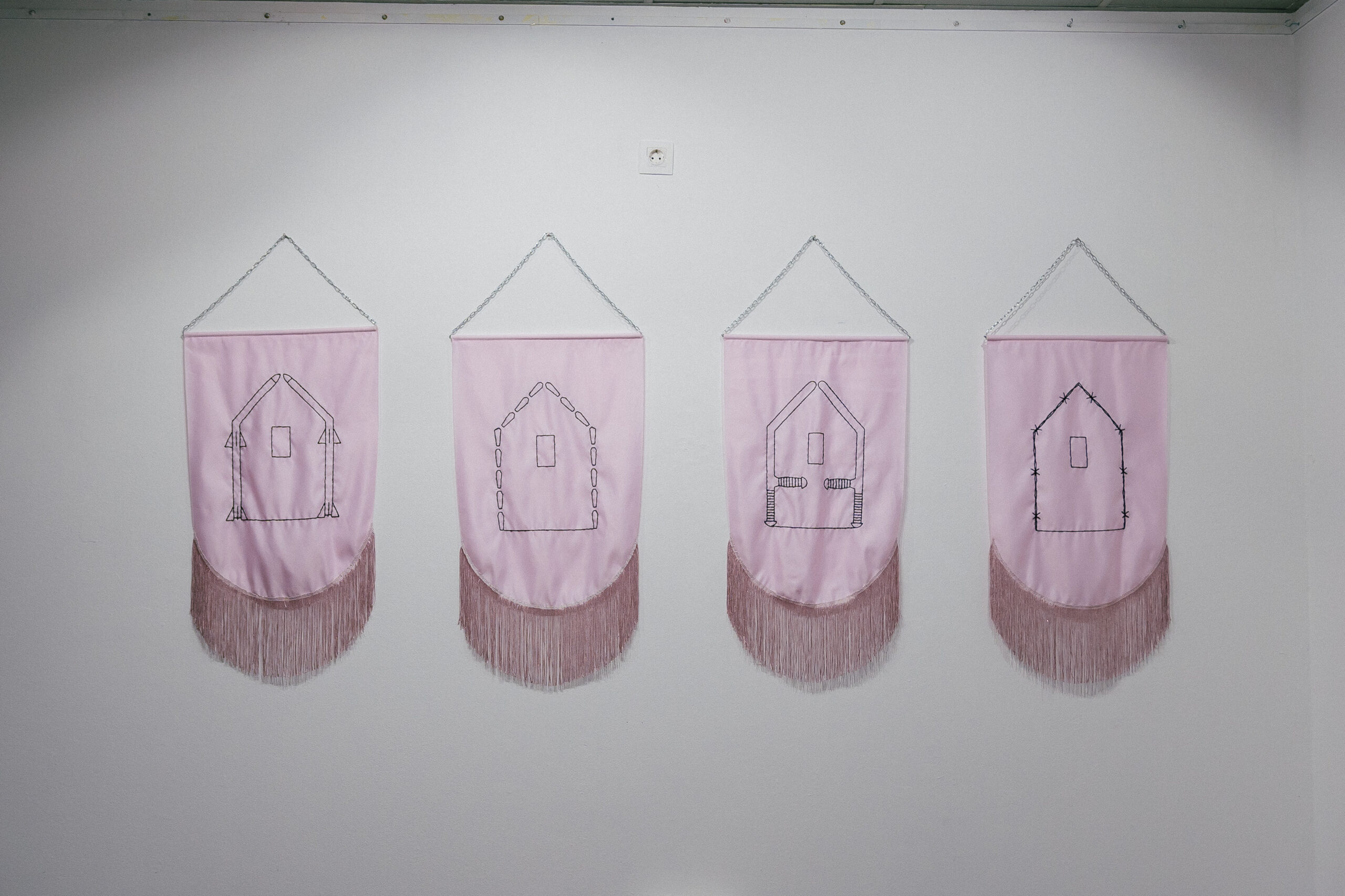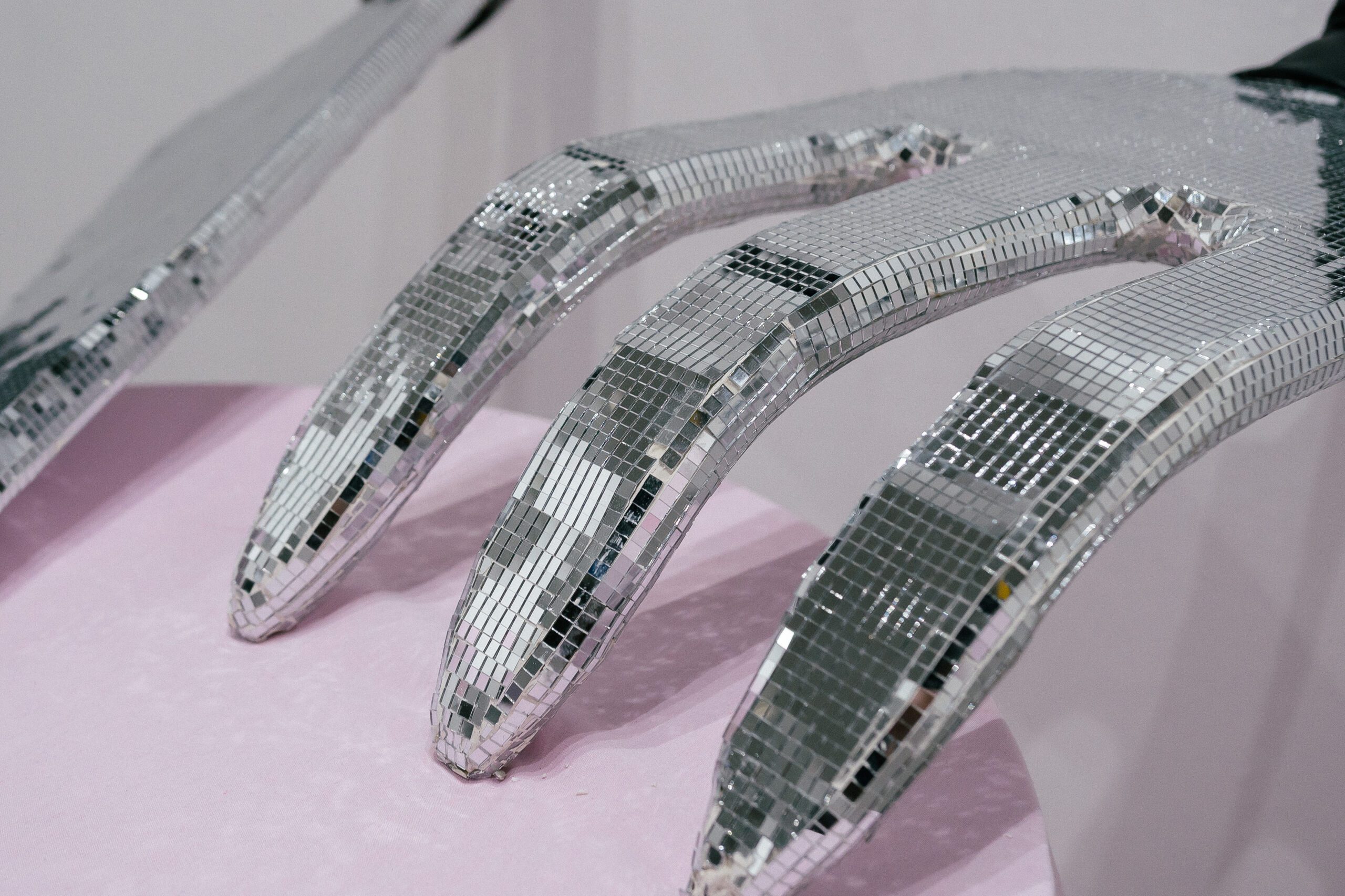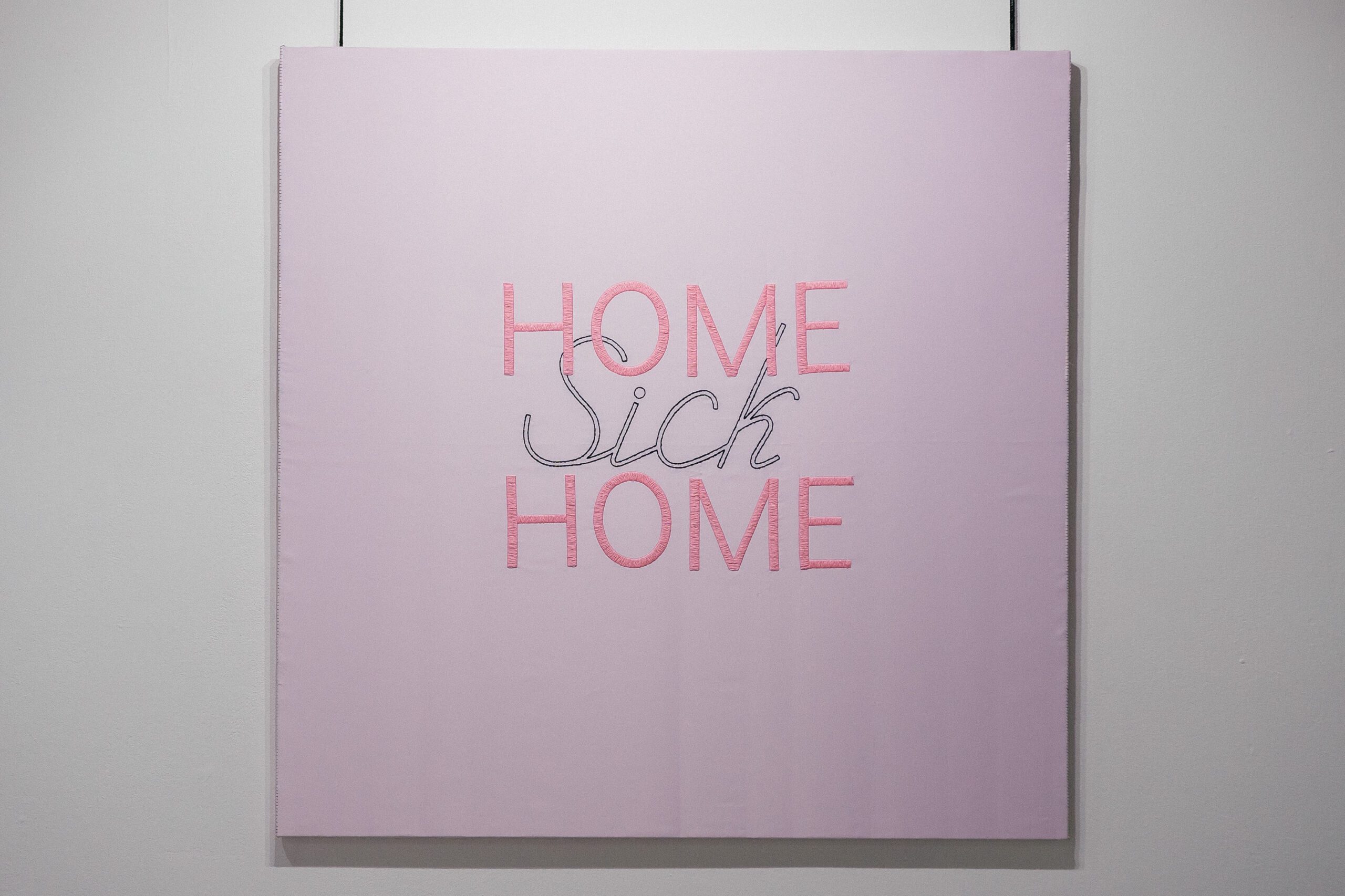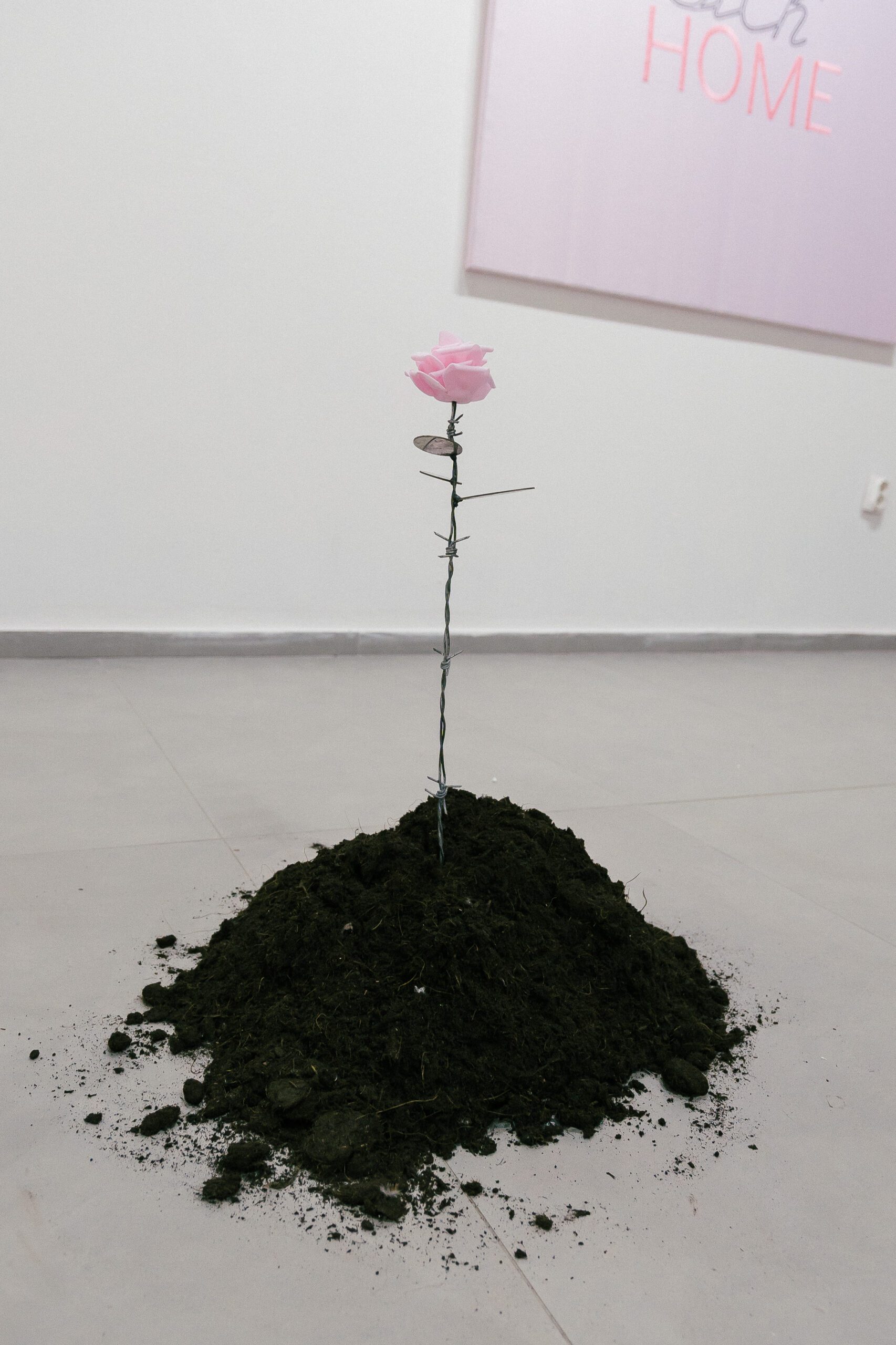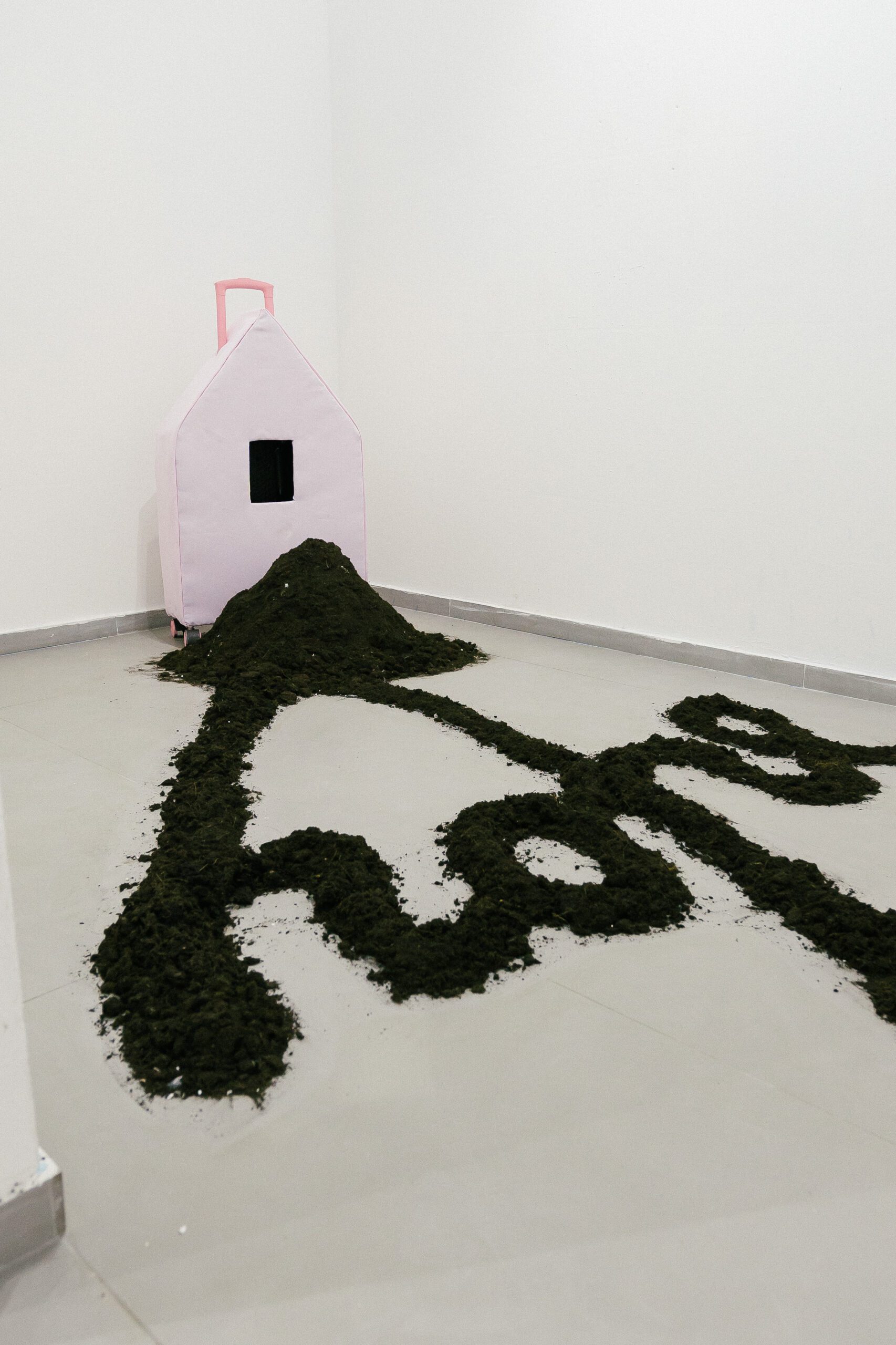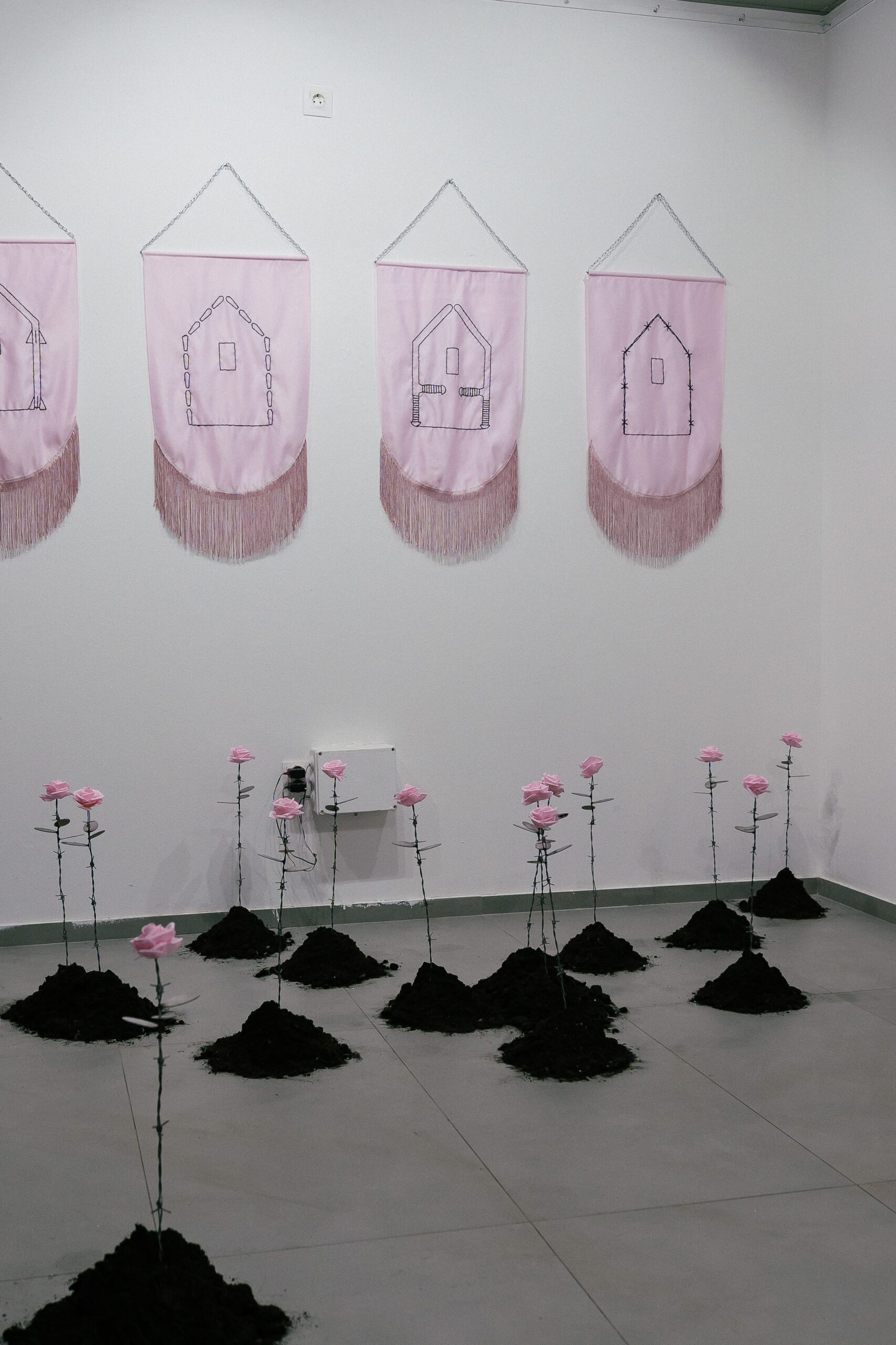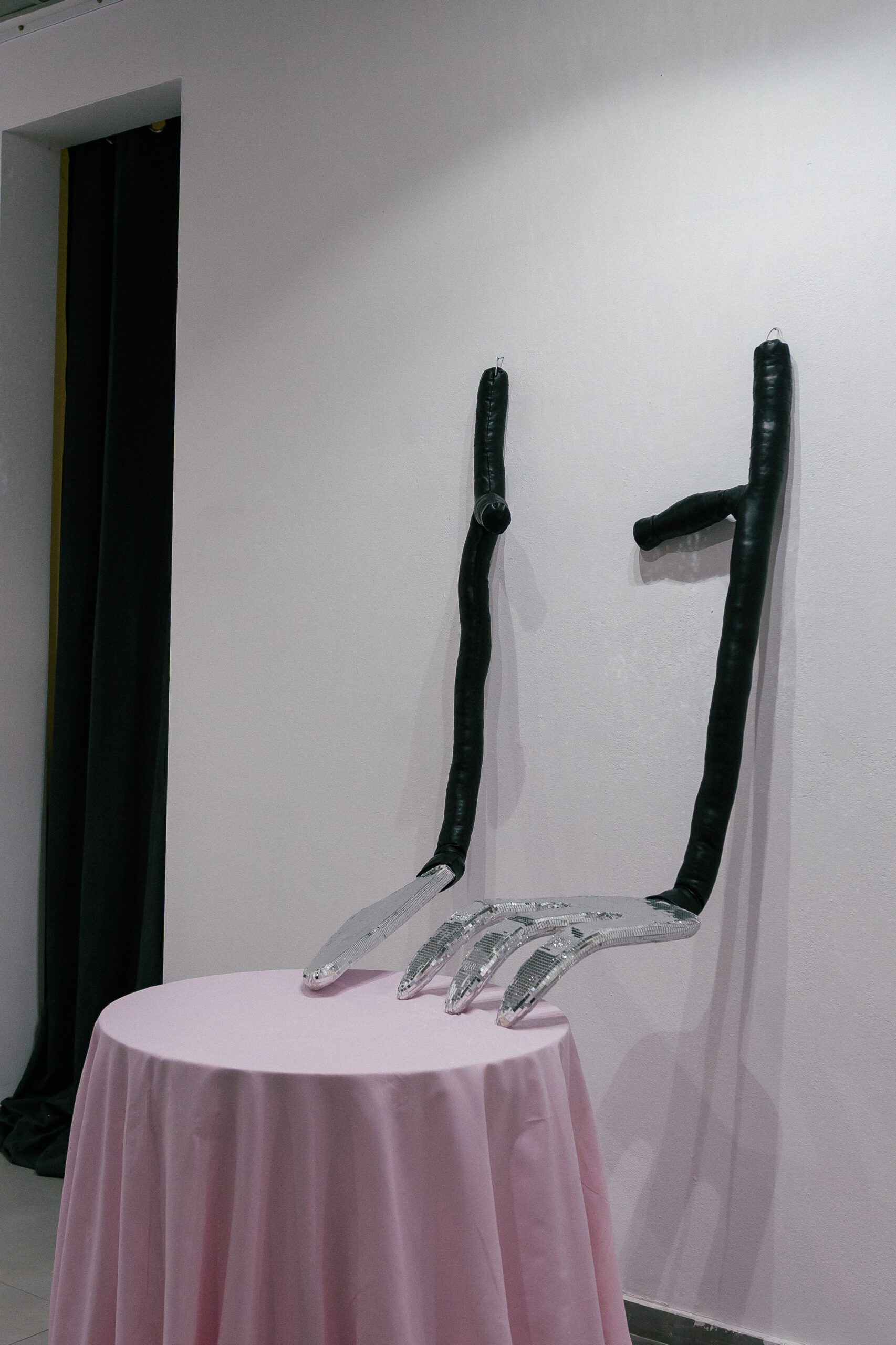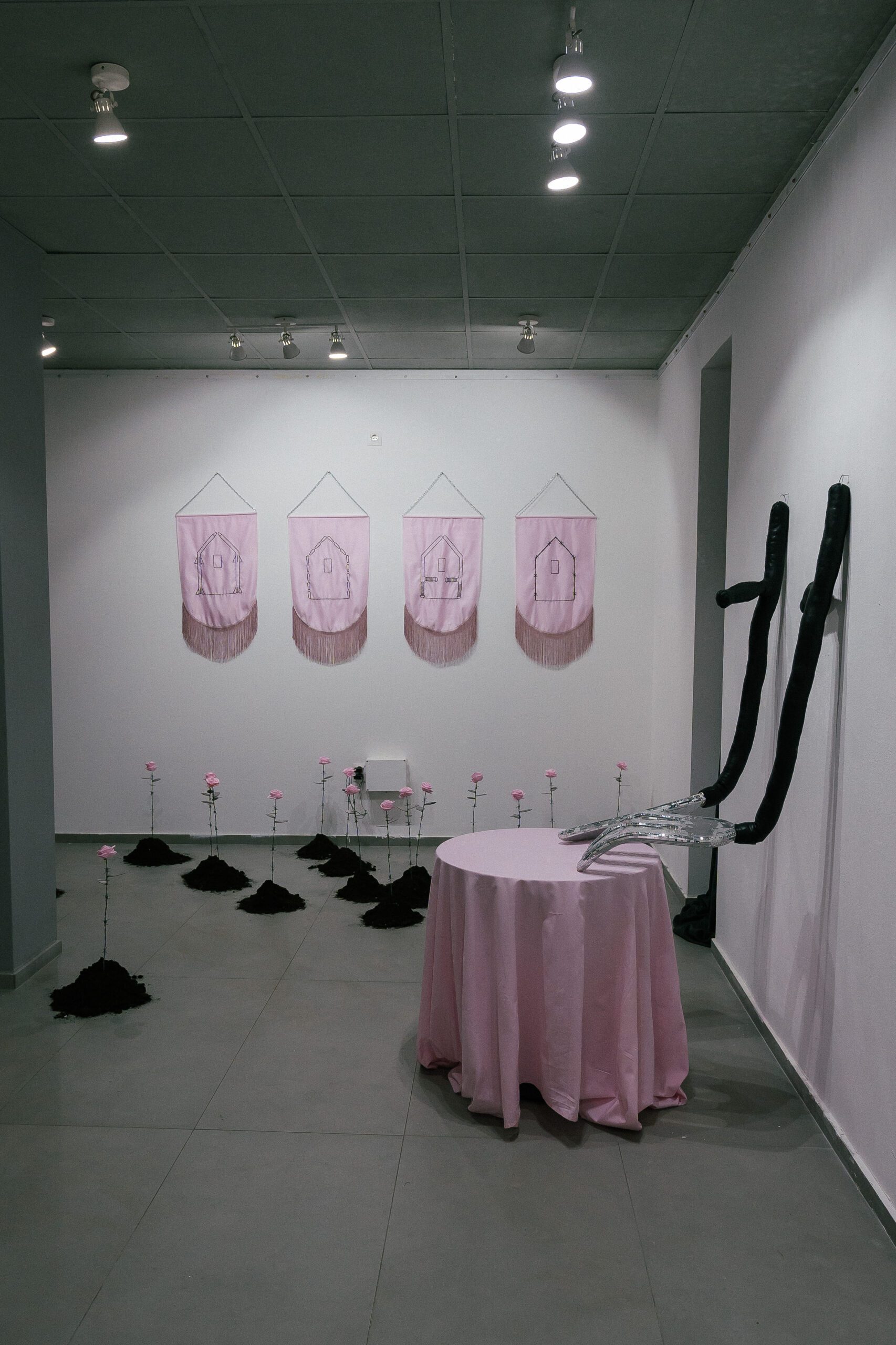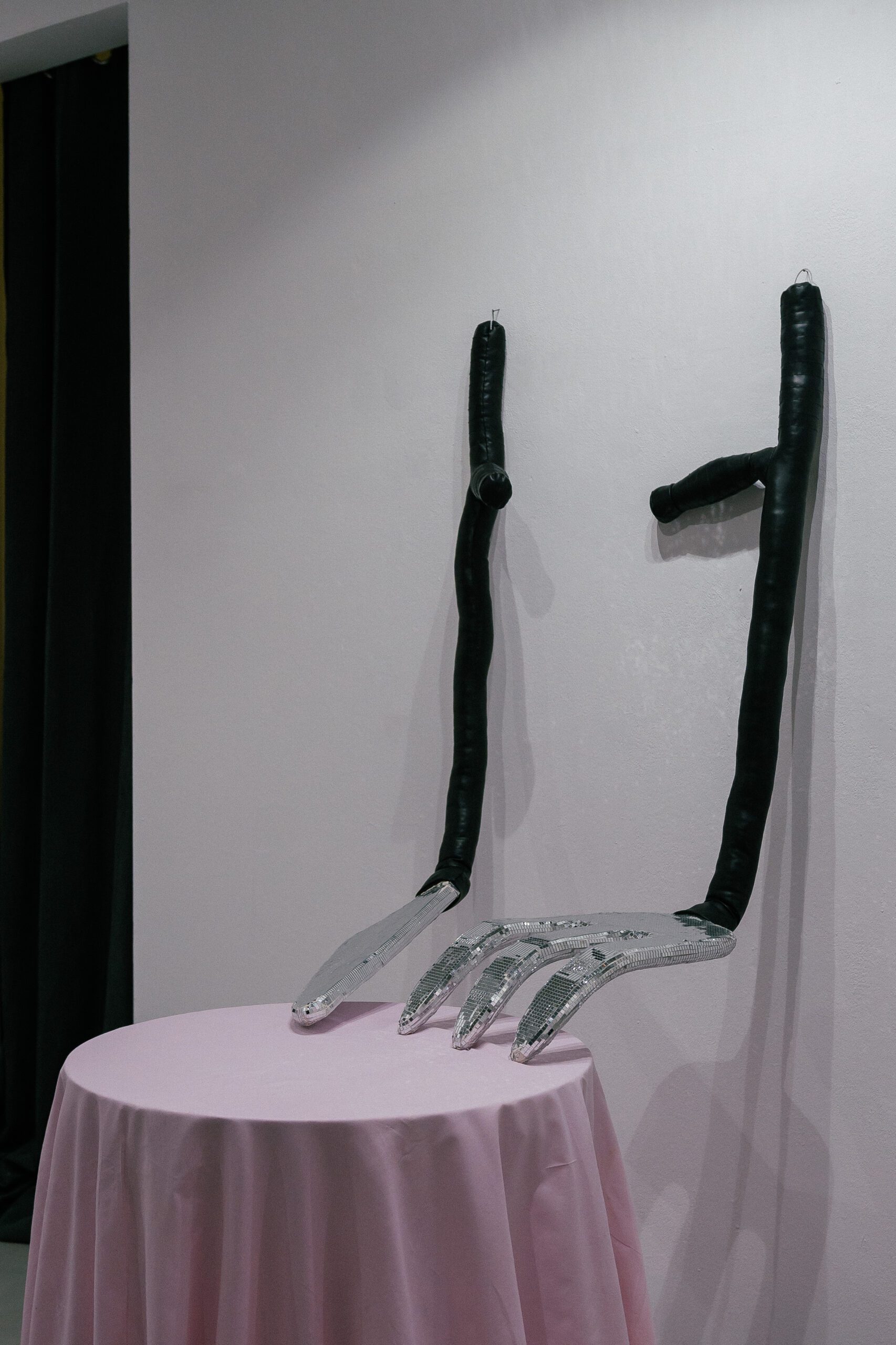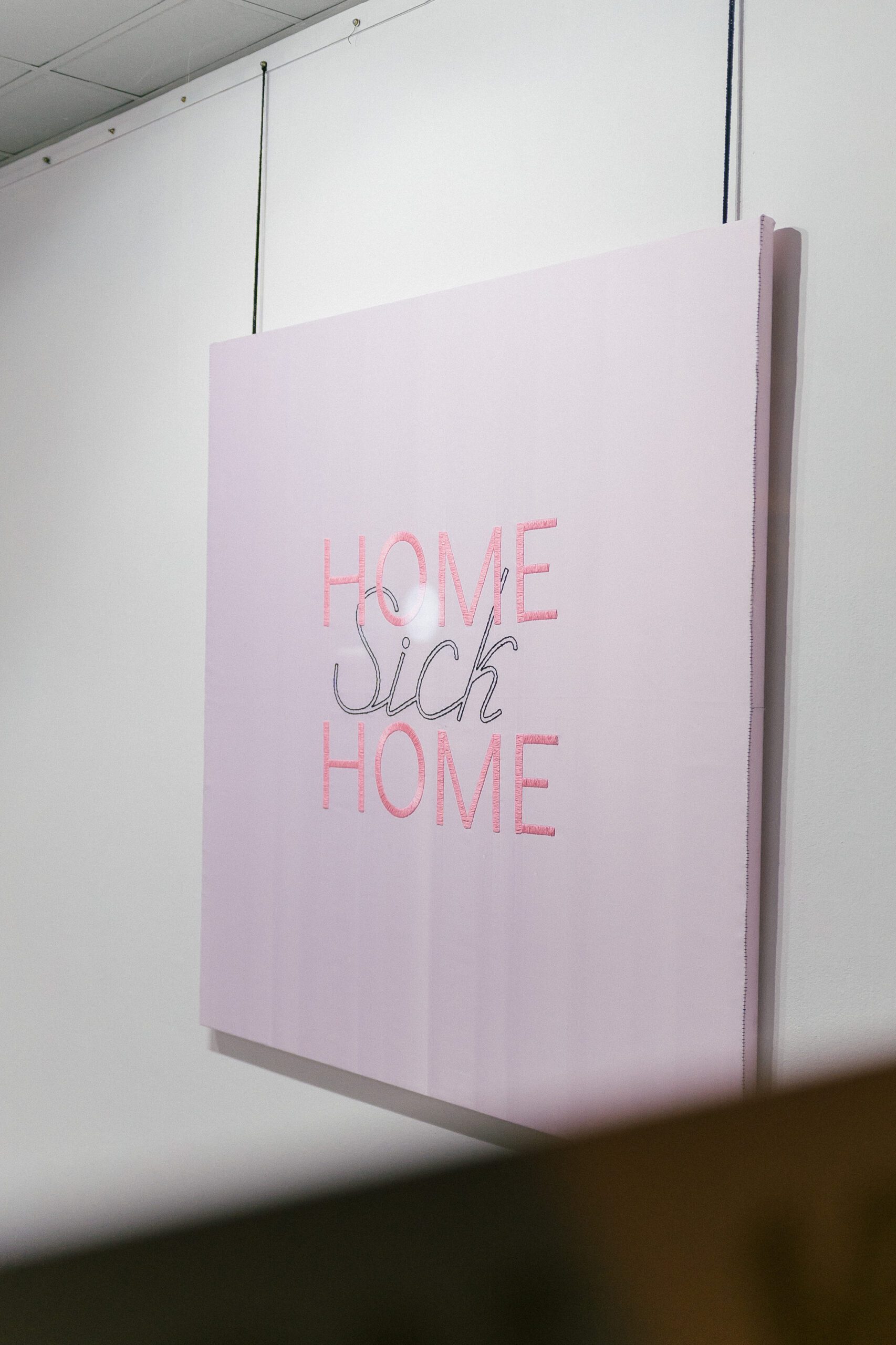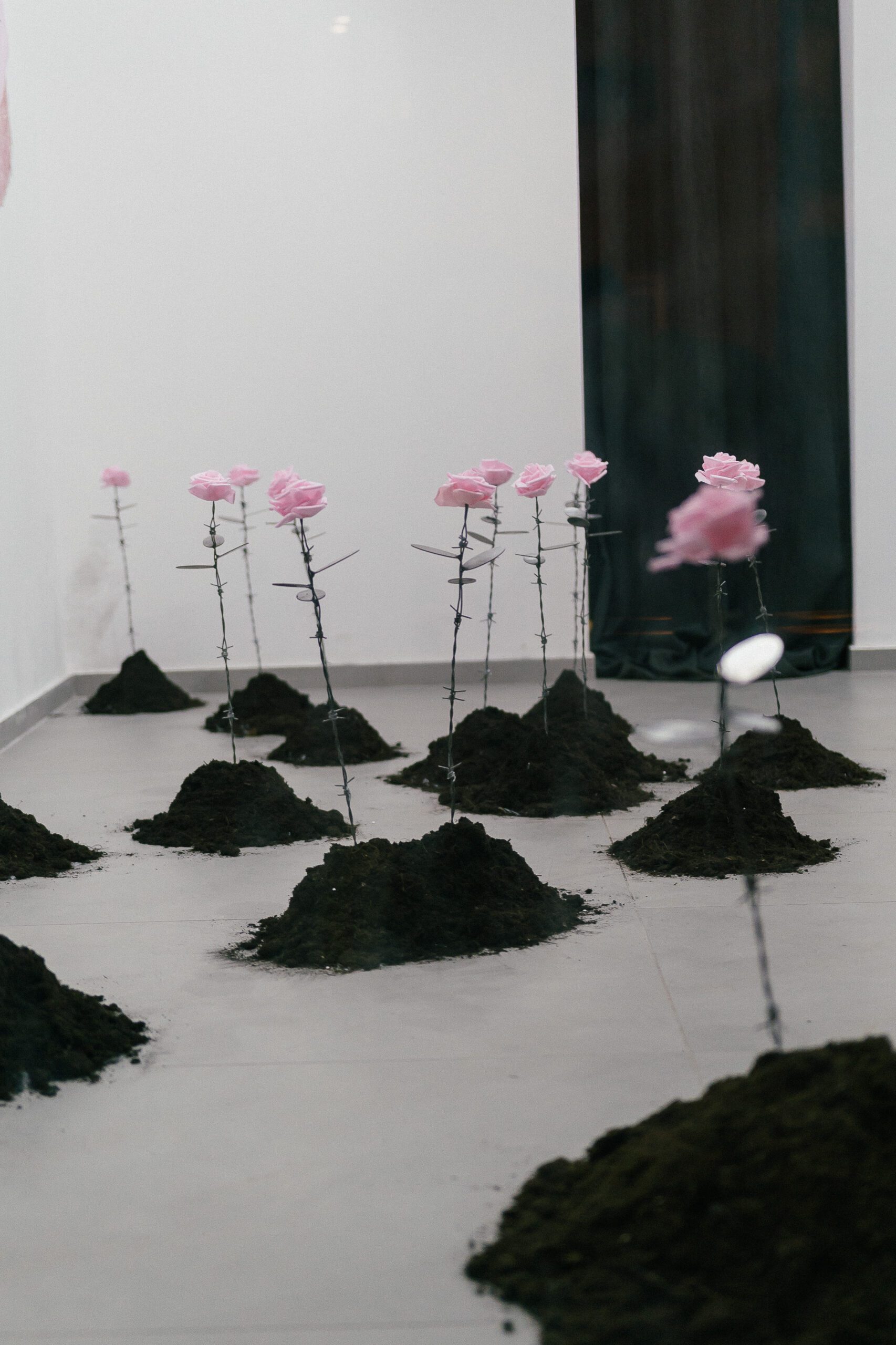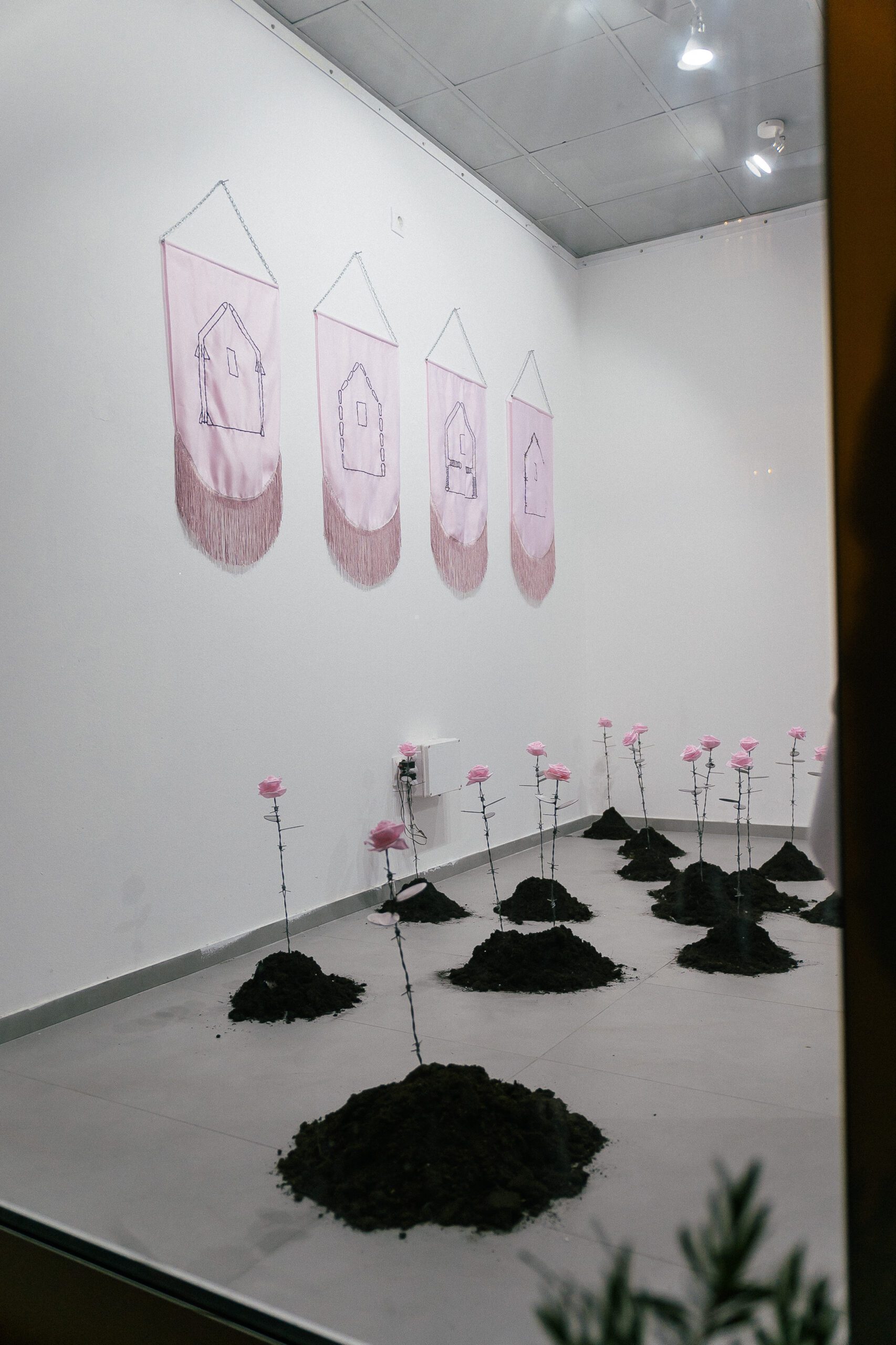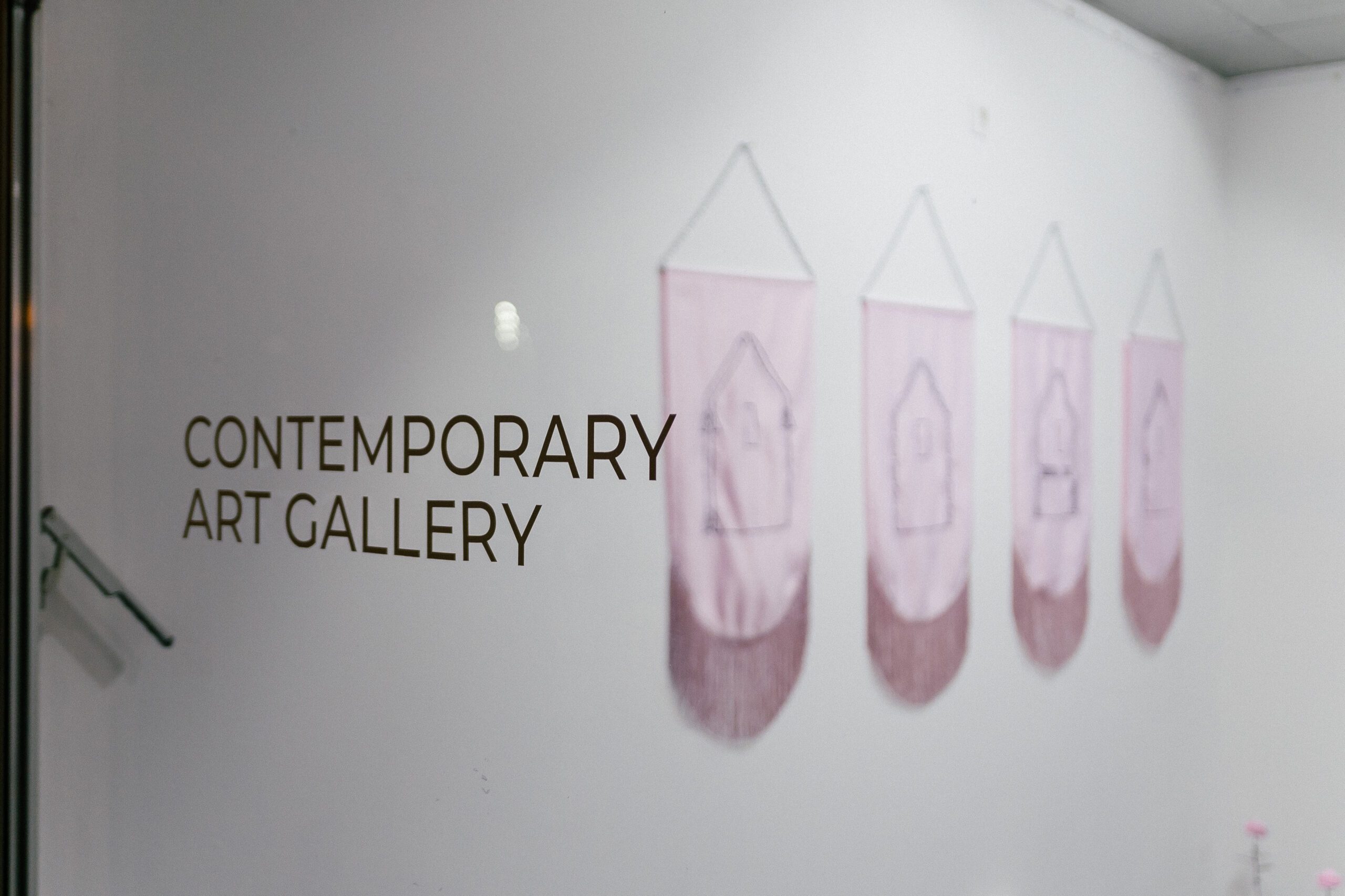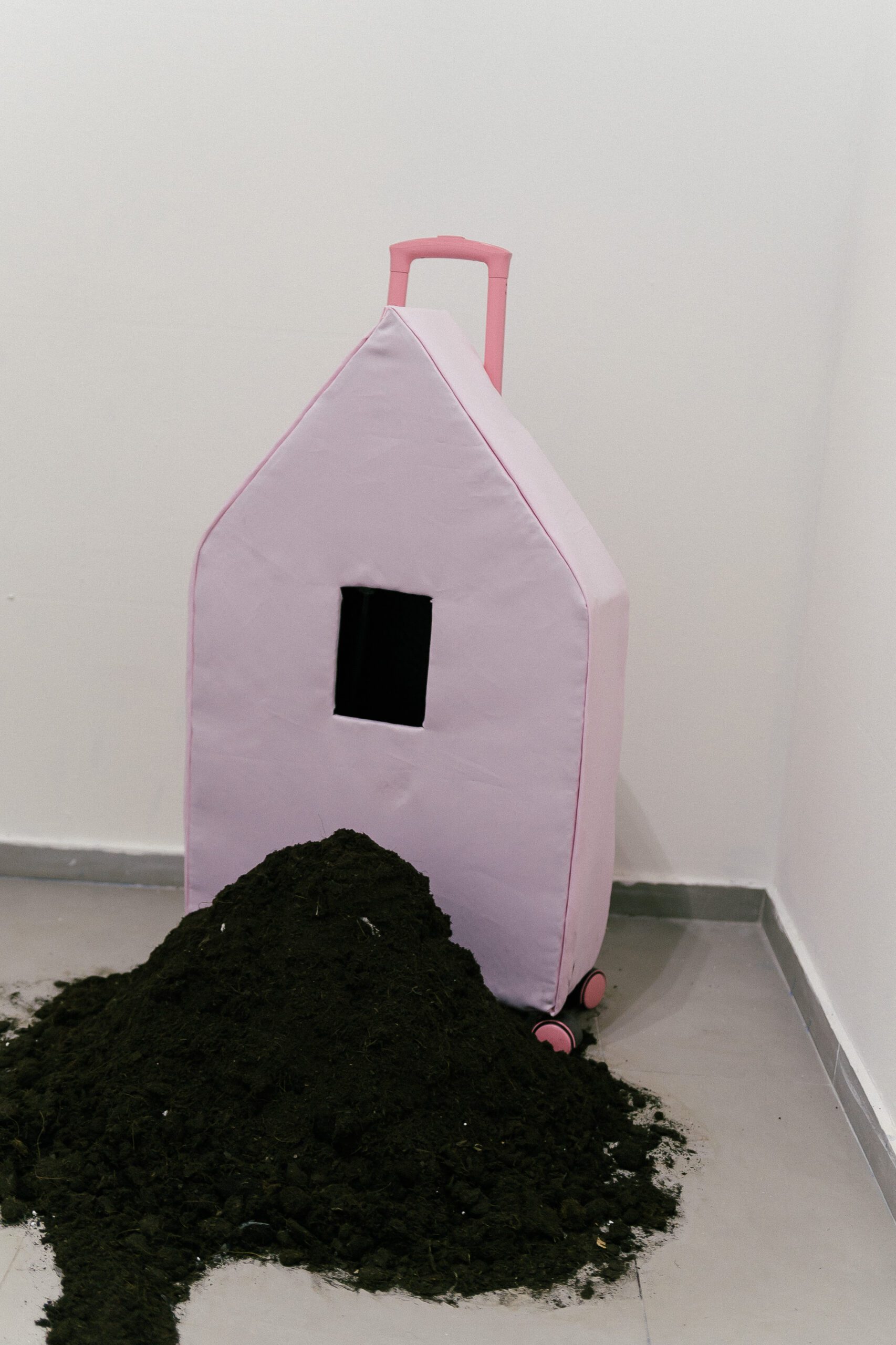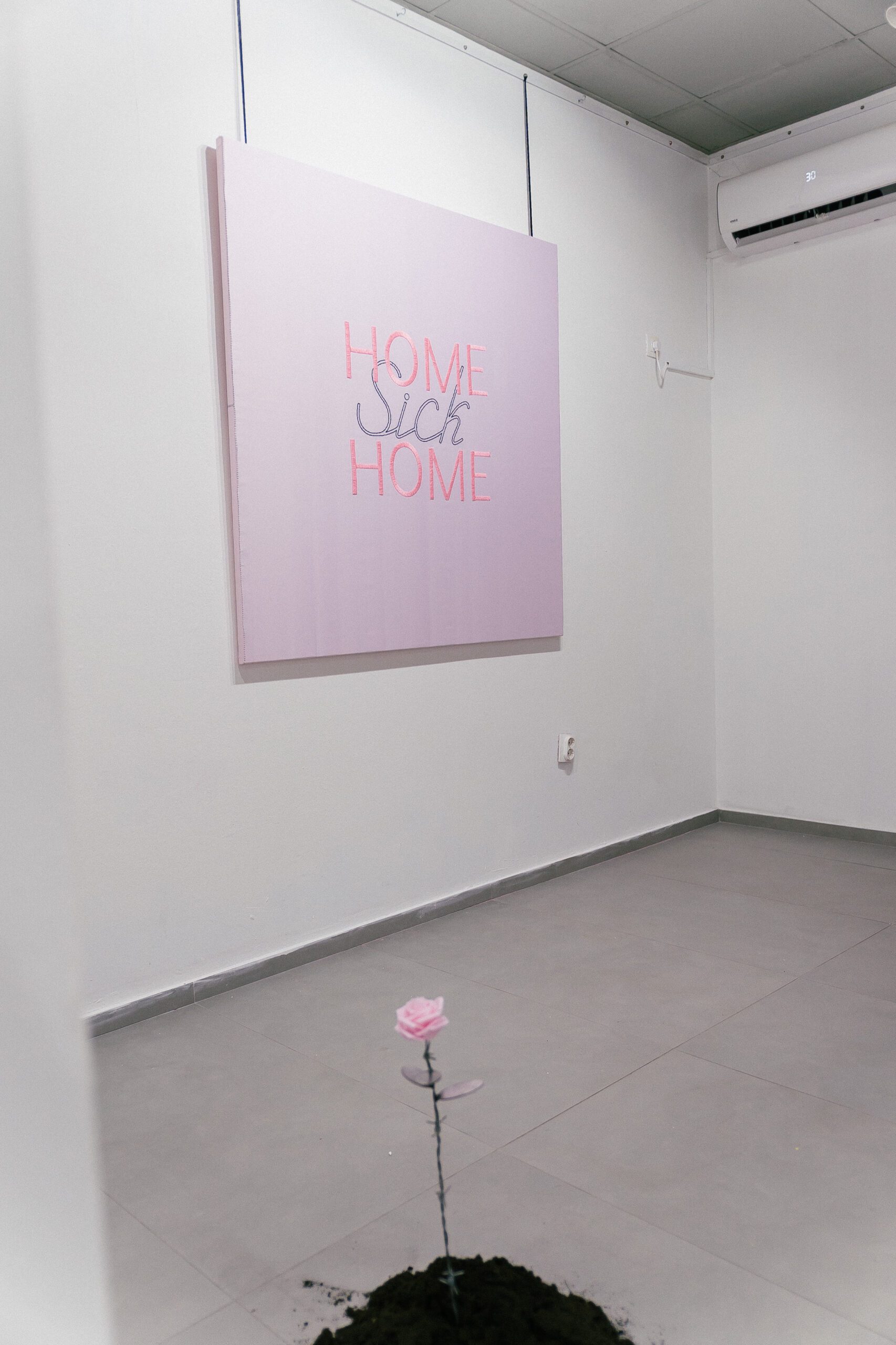
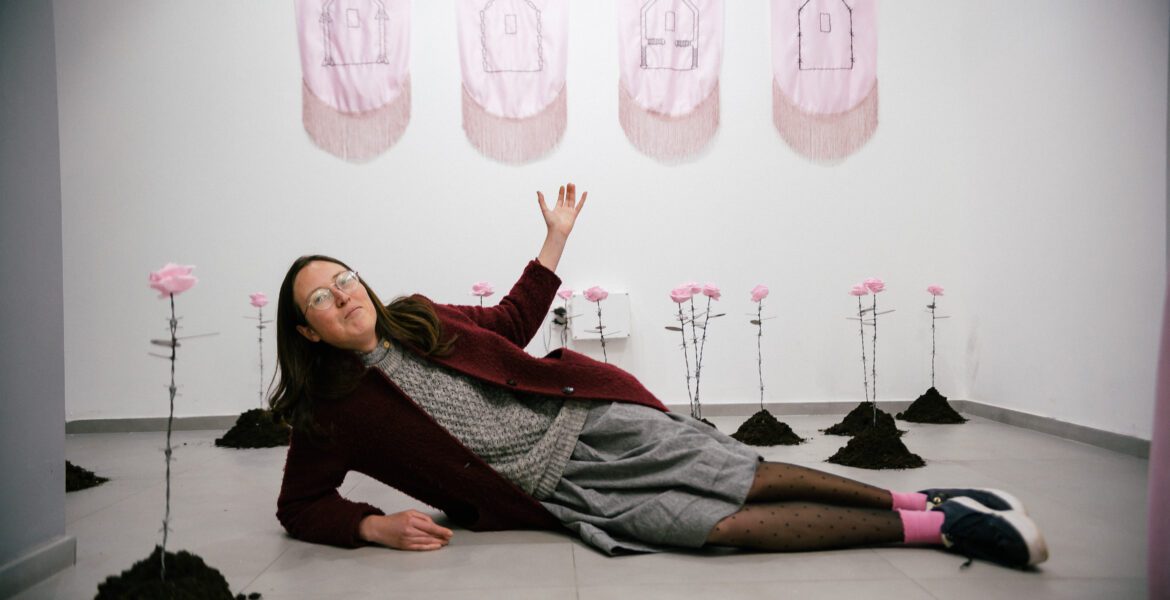
In this exhibition, Lada Ucheva establishes a complex visual and political framework in which the motif of home is formed within experiences of a war zone, violent migration, and systemic repression. The space that opens before us is structured through a clash of intensities: gentle, almost sentimental visual segments coexist with rough, raw elements, producing an atmosphere in which perception constantly oscillates between attraction and unease. The iconography of roses, houses, and pink tones functions as a precisely constructed apparatus of visual suggestion. These elements activate deeply rooted images of safety, intimacy, and emotional warmth, guiding the viewer into a space that promises stability and protection. Their formal softness and aesthetic accessibility generate a sense of closeness—an almost automatic identification with the idea of home as a refuge. It is precisely within this register of softness that the unsettling effect intensifies. Rough materials, sharp cuts, disciplined structures, and repetitive systems introduce another layer, carrying the experience of violence, control, and coercion. Their presence does not break the surface but intertwines with it, creating a continuum in which softness and brutality amplify one another. The gentle motifs become carriers of pressure, while the rough elements assume the role of structural frameworks that organize and confine the space. This tension produces a specific form of unease that does not arise from a direct representation of violence, but from its dispersion through form. The visual language functions as a system in which the political is inscribed into rhythm, material, and repetition. Repetition further condenses this experience, transforming individual elements into accumulated structures that insist on duration and exposure. Within this system, home is articulated as a space in which safety and violence continually overlap. War, migration, and political repression act as forces that shape perception and define the boundaries of the possible, while the body and mind remain under their continuous pressure. Silencing, control, and exclusion function as operative principles that shape both the space and the subject’s experience within it. This practice produces a situation in which visual softness intensifies the awareness of the violence that structures it. The viewer is confronted with an environment that demands prolonged engagement, and whose perceptual impact is continually regenerated through the tension between the appealing and the burdensome.
Text: Isidora Branković
Lada Uchayeva (born 1992 in Saratov, Russia) is a contemporary multidisciplinary artist who lives and works in Montenegro. She graduated from the Stieglitz Academy of Art and Design (2015) and completed the Paideia School of Contemporary Art Interpretation (2016). In her work, she addresses themes of economic inequality, political repression, violence, and labor.
She works with various materials such as textile, metal, glass, and paper, but her practice is fundamentally defined by text and repetition. Through the repetition of words, movements, and forms, she builds works that accumulate meaning, time, and labor, making the creative process visible and amplifying the idea being conveyed.
Her recent solo exhibitions include Antifragility (Cirih, 2026), 99% at SpazioSERRA gallery (Milan, 2025) and White Noise in the European Art Community (Budva, Montenegro, 2024). She is a recipient of the Garage Museum Young Artist Support Program scholarship (2022). Her practice stems from an understanding of art as an inherently political space, open to multiple interpretations.